
Introduction
Dreaming of building a career in the heart of Europe? Austria offers a high quality of life, robust economic stability, and a clear pathway for skilled professionals to settle long-term. Navigating the immigration process, however, often feels like a puzzle. That is where the Austria PR Points Calculator becomes your most valuable tool.
The Red-White-Red (RWR) Card is the backbone of Austrian skilled immigration. It is a points-based system designed to attract global talent. Understanding how you score against these criteria is not just helpful—it is the first step toward securing your future. This guide breaks down the complex scoring metrics into simple, actionable steps, helping you assess your eligibility for work and residency in Austria.
Whether you are a software developer looking to innovate or a healthcare professional seeking new challenges, Europe’s job market is waiting. By aligning your career profile with Austrian requirements, you aren’t just moving to a new country—you are opening the door to unmatched professional growth and a life of stability in one of the world’s most developed nations.
What Is Austria PR Points Calculator?
The Austria PR Points Calculator is an essential orientation tool that helps you estimate where you stand regarding the government’s immigration criteria. Austria uses a points-based system to ensure that incoming workers have the skills, language ability, and professional background to thrive in the local economy.
How It Works
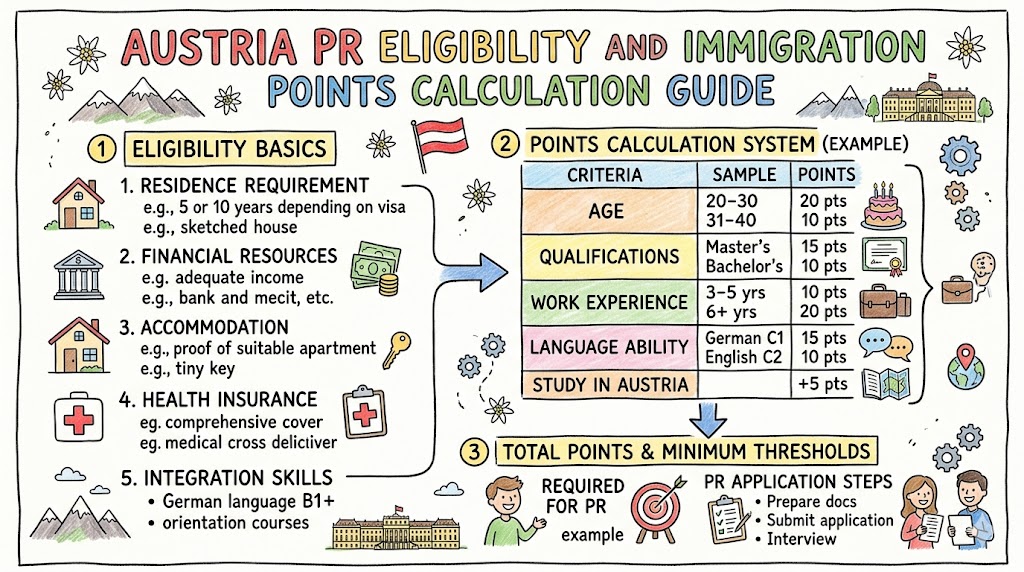
The system allocates points based on factors such as education, age, work experience, and language proficiency. Depending on your professional category (e.g., Highly Qualified Worker vs. Skilled Worker in a Shortage Occupation), there is a minimum points threshold you must meet to be considered for a visa.
Eligibility vs. Approval
It is important to remember that this calculator provides an estimate. Official points are awarded by the Public Employment Service (AMS) during your formal application. Meeting the minimum threshold is a prerequisite, but it does not guarantee automatic approval. The process also includes labor market tests and salary threshold requirements.
Austria PR Points System Explained
To succeed, you must understand what earns you points. While specific requirements vary by category, the core pillars remain consistent.
- Education: Holding a recognized university degree or specialized vocational training can earn you significant points.
- Work Experience: Every half-year of relevant experience adds to your score, with extra credit for experience gained within Austria.
- Age: Younger applicants often receive higher points, as they are expected to contribute to the labor market for a longer duration.
- Language Skills: Proficiency in German is highly valued, but English proficiency and knowledge of other regional languages can also boost your score.
- Bonus Points: Certain categories offer bonuses for innovation, research, or securing a position in a company where English is the primary language.
Example: If a candidate has a Master’s degree (30 points) and 5 years of relevant work experience (10 points), they start with a strong foundation before even adding language or age factors.
Red-White-Red Card System
The RWR Card is not a “one size fits all” document. It is categorized to suit different types of professionals.
RWR Card Categories Comparison
| Category | Best For | Requirement Focus |
| Very Highly Qualified | Experts with research/innovation | Points-based (no job offer needed initially) |
| Shortage Occupations | Professionals in high-demand fields | Job offer required + points minimum |
| Other Key Workers | General skilled professionals | Job offer required + points minimum |
| Startup Founders | Innovative entrepreneurs | Capital investment + business plan |
How Austria PR Points Are Calculated
Calculation is a systematic process. First, determine your category. Then, total your points against the official benchmarks. Below is a breakdown of how the scoring is weighted across standard applications.
Scoring Weightage Table
| Factor | Scoring Basis | Impact Level |
| Qualifications | Degrees, Vocational training | High |
| Work Experience | Duration and location (Austria vs. abroad) | Medium-High |
| Language Skills | German (A1-C2) and English | Medium |
| Age | Based on age bands | Low-Medium |
Sample Profile Calculation (Shortage Occupation)
- Education: Vocational training in shortage field (30 pts)
- Work Experience: 4 years (8 pts)
- Language: German A2 (10 pts)
- Age: Under 30 (15 pts)
- Total: 63 points (Exceeds the 55-point minimum)
Step-by-Step Application Process
- Check Eligibility: Use the calculator to see if you meet the minimum threshold.
- Collect Documents: Gather degrees, certificates, and employment history.
- Job Offer: Secure a contract that meets salary requirements (for most RWR categories).
- Submit Application: Apply through the Austrian embassy or local residency authority.
- AMS Evaluation: The authorities review your points and the local labor market conditions.
- Approval: Upon success, you receive your RWR Card for 24 months.
Documents Required
- Valid Passport: Must be current for the duration of your stay.
- Degree and Diploma Certificates: Must be translated and potentially apostilled.
- Detailed Work Experience Letters: Stating roles and responsibilities.
- Language Proficiency Certificates: Recognized tests like ÖSD, Goethe, or IELTS.
- Signed Job Contract: Must explicitly state salary and work hours.
- Proof of Accommodation: Lease agreement or confirmation of housing.
Processing Time & Validity
The processing time can vary based on your local embassy’s workload and the complexity of your file. Generally, once issued, the RWR Card is valid for two years. This period allows you to work for the employer specified in your application. After 21 months of qualifying employment, you may become eligible for the RWR Card Plus, which grants unrestricted access to the Austrian labor market.
How to Increase Your Austria PR Points
If you are just shy of the required score, focus on these strategies:
- Learn German: Even an A1 or A2 certification can push you over the threshold.
- Gain Targeted Experience: Ensure your work history aligns perfectly with your job description.
- Research Shortage Occupations: Check if your profession is currently on the official shortage list, as this often lowers the points requirement.
- Professional Certification: Consider short-term, high-value training that aligns with Austrian industry standards.
Common Mistakes Applicants Make
- Wrong Category Selection: Applying under the wrong category can lead to immediate rejection.
- Missing Documentation: Incomplete proofs for education or work history will stall your application.
- Assuming Points are Enough: Forgetting that an actual job offer or salary threshold must be met alongside the points.
- Language Certificates: Relying on self-assessment instead of official, recognized test results.
Real-Life Examples
IT Professional (Shortage Occupation)
- Profile: 28 years old, Bachelor’s in CS, 3 years experience.
- Points: Qualification (30) + Experience (6) + Language (10) + Age (15) = 61.
- Outcome: Highly likely to qualify for an RWR Card.
Skilled Admin Assistant (Other Key Worker)
- Profile: 42 years old, Tertiary degree, 5 years experience, English B1.
- Points: Qualification (20) + Experience (10) + Language (10) = 40.
- Outcome: Below the 55-point minimum. Needs to improve German or gain more experience.
FAQs
- What is the Austria PR Points Calculator? It is a tool to estimate your eligibility for the Red-White-Red Card based on official immigration criteria.
- Is German required for Austria PR? It is not strictly mandatory for all work visas, but it significantly boosts your points and integration score.
- How many points are needed? Depending on the category, the minimum is typically between 50 and 70 points.
- Can I apply without a job offer? Only “Very Highly Qualified” workers can apply for a Job Seeker Visa without a prior job offer.
- How long does the RWR Card process take? Timelines vary, but it typically ranges from several weeks to a few months.
- Can I convert RWR to PR? Yes, the RWR Card is a stepping stone to long-term residency (RWR Card Plus and eventually permanent settlement).
- What is a shortage occupation? It is a field where Austria faces a lack of qualified local workers, making it easier for skilled foreigners to qualify.
- Does my age affect my points? Yes, younger applicants (usually under 35 or 40) generally earn more points.
- Can I apply if I am currently in Austria? Yes, certain applications can be filed at the provincial authorities if you are already residing in the country legally.
- Do I need an immigration lawyer? While not required, a lawyer can help if your profile is complex or if you have faced previous rejections.
Conclusion
Embarking on the journey toward an Austrian Red-White-Red Card is more than just a bureaucratic process; it is a strategic investment in your future. Austria represents a unique intersection of economic stability, cultural richness, and career potential. By utilizing the Austria PR Points Calculator as a foundational element of your planning, you transform a vague ambition into a concrete, measurable roadmap.
Success in the immigration system is rarely about luck; it is about preparation. Whether you find that your current score is already sufficient or that you have specific areas—such as language acquisition or targeted professional development—to improve upon, this clarity is your greatest advantage. Do not be discouraged by the complexity of the requirements. Instead, view them as steps toward becoming a highly competitive candidate in the European labor market.
Now is the time to take decisive action. Begin by organizing your documentation, identifying gaps in your eligibility, and actively engaging with the Austrian professional landscape. With a focused strategy and a commitment to meeting these criteria, you are well on your way to securing your place in one of the world’s most rewarding professional environments. Your European dream is achievable; start building it today.