
Introduction
In the rapidly shifting landscape of modern software engineering, the lines separating development, infrastructure, security, and data science have largely blurred. Modern delivery pipelines demand that engineering teams deploy code multiple times a day safely, monitor massive containerized infrastructures, secure workloads before they hit production, and integrate complex machine learning systems. Navigating this vast landscape requires clear validation of your expertise.
For professionals looking to advance, choosing a concrete learning roadmap is the single most effective way to cut through the industry noise. Finding the right certification serves as an optimized, structured framework that transforms overwhelming technical concepts into distinct milestone achievements.
What is a DevOps Certification?
A DevOps certification is an industry-recognized credential that validates a professional’s theoretical knowledge and practical competence in automating, managing, and optimizing the software delivery lifecycle. Rather than just reading documentation or watching unstructured tutorials, pursuing a certification forces you into a structured learning path.
These programs test your ability to build robust continuous integration and continuous deployment (CI/CD) pipelines, configure cloud infrastructure via code, orchestrate containerized applications, and maintain system health using advanced monitoring platforms. By earning a certification, you provide verifiable proof to employers that your technical skills have been tested and approved against rigid real-world operational standards.
Why DevOps Certifications Matter
The global transition toward cloud-native architecture has made continuous automation an industry baseline rather than a luxury. Relying entirely on generic job experience without technical validation can stall your career momentum.
To systematically elevate your engineering career, consider this straightforward step-by-step approach:
- Establish an Objective Benchmarking Standard: Certifications eliminate ambiguity during technical screenings by offering clear proof of your capability to manage real-world systems.
- Accelerate Upward Career Transitions: Moving from standard system administration or software engineering into specialized roles like Site Reliability Engineering (SRE), DevSecOps, or MLOps requires verified proof of architectural design and security automation proficiency.
- Bridge Critical Skill Gaps: Preparing for exams exposes you to edge cases, architectural patterns, and diagnostic strategies that you might never encounter in your day-to-day work tasks.
- Command Premium Compensation: Enterprise organizations actively seek certified specialists to lead multi-cloud migrations and platform engineering overhauls, offering significantly higher compensation packages to certified talent.
Who Should Take DevOps Certifications?
DevOps principles have expanded far beyond traditional systems operations, making structured certification paths highly valuable for a wide variety of roles across tech:
- Students and Freshers: Looking to build a standout technical portfolio and enter the tech industry with market-ready, hands-on infrastructure skills.
- Software Engineers & QA Professionals: Aiming to break down the walls between application development and deployment by mastering test automation and continuous delivery.
- System Administrators & Cloud Engineers: Eager to transition away from manual configuration tasks and evolve into modern infrastructure automation specialists.
- DevSecOps & Security Professionals: Focused on automating policy enforcement and embedding vulnerability scanning directly into active deployment pipelines.
- Data & Machine Learning Engineers: Needing to design reliable, automated versioning systems and scalable pipelines for training and serving production AI models.
- SREs & Platform Engineers: Tasked with maintaining high system availability, enforcing reliable metric reporting, and lowering platform downtime.
- IT Managers & Technical Leads: Seeking to properly evaluate architecture choices, optimize infrastructure budgets, and champion modern engineering practices across their teams.
Core Skills Covered
A comprehensive certification journey equips you with a versatile, end-to-end engineering toolkit across several foundational categories:
- Source Code Management & GitOps: Managing infrastructure state and deployment configurations declaratively using Git as the single source of truth.
- Continuous Integration & Delivery (CI/CD): Writing automated code compilation, testing, and deployment workflows that safely guide code changes from commits to active production.
- Containerization & Orchestration: Packaging isolated microservices inside light container runtimes and managing them across large cluster environments.
- Infrastructure as Code (IaC): Eliminating manual server configuration by writing declarative, reusable code scripts to provision and scale entire cloud topologies.
- Cloud Architecture & Engineering: Designing scalable, secure, and cost-optimized infrastructure networks across major public cloud vendors.
- Monitoring, Observability & Site Reliability: Gathering live logs, tracking system metrics, and tracing performance bottlenecks to preemptively address platform outages.
- Machine Learning Operations (MLOps): Automating the retraining, validation, auditing, and scaling of analytical data systems in production environments.
The Top 20 Best DevOps Certifications
The table below details twenty premier certification options across the DevOps, Cloud, Security, and AI/ML landscapes. Each entry targets distinct engineering roles and skill levels.
Table 1: Master Industry Certifications Overview
| Certification Name | Best For | Skill Level | Career Direction |
| 1. DevOps Certified Professional (DCP) | Core DevOps Frameworks & Multi-Tool Mastery | Fundamental to Intermediate | DevOps Engineer, Release Manager |
| 2. DevSecOps Certified Professional (DSOCP) | Automated Security, CI/CD Hardening & Compliance | Intermediate to Advanced | DevSecOps Engineer, Security Architect |
| 3. Site Reliability Engineering (SRE) Certified Professional | High Availability, SLIs/SLOs & Incident Response | Intermediate to Advanced | Site Reliability Engineer, Operations Lead |
| 4. Master in DevOps Engineering (MDE) | End-to-End Enterprise Software Delivery Pipelines | Intermediate to Advanced | Principal DevOps Engineer, Platform Lead |
| 5. Master in Azure DevOps | Microsoft Azure Cloud Solutions & Native Tooling | Intermediate to Advanced | Azure Cloud Architect, Azure DevOps Engineer |
| 6. AWS Certified DevOps Professional | Amazon Web Services Automation & Systems Architecture | Advanced | AWS Solutions Architect, Cloud DevOps Specialist |
| 7. Master in Python Programming | Infrastructure Scripting, Automation & Core Coding | Beginner to Intermediate | Automation Engineer, Software Developer |
| 8. HashiCorp Certified Terraform Associate | Multi-Cloud Infrastructure as Code (IaC) Provisioning | Intermediate | Cloud Infrastructure Engineer, IaC Specialist |
| 9. Certified Kubernetes Administrator (CKA) | Enterprise Container Orchestration & Cluster Management | Intermediate to Advanced | Kubernetes Administrator, Platform Engineer |
| 10. Docker Certified Associate (DCA) | Microservices Containerization & Image Architecture | Fundamental to Intermediate | Container Specialist, Cloud Engineer |
| 11. Envoy ISTIO Certification Training | Service Mesh Management, Microservices Traffic & Telemetry | Advanced | Service Mesh Engineer, Network Architect |
| 12. MLOps Certification Training Course | Machine Learning Pipeline Automation & Deployment | Intermediate to Advanced | MLOps Engineer, Data Platform Specialist |
| 13. Google Cloud Professional Cloud DevOps Engineer | Google Cloud Platform Optimization & Site Reliability | Advanced | GCP DevOps Engineer, Cloud SRE |
| 14. Master in Machine Learning | Mathematical Modeling, Data Algorithms & Analytics | Intermediate to Advanced | Machine Learning Engineer, Research Scientist |
| 15. Master in Artificial Intelligence | Neural Network Architectures & Intelligent Systems | Advanced | AI Engineer, Intelligent Systems Developer |
| 16. Master in AppDynamics | Enterprise Application Performance Monitoring (APM) | Intermediate | Performance Engineer, Observability Specialist |
| 17. Master in Data Science | Big Data Analysis, Statistical Modeling & Insights | Intermediate to Advanced | Data Scientist, Quantitative Analyst |
| 18. Master in Deep Learning | Advanced Computer Vision & Natural Language Processing | Advanced | Deep Learning Specialist, NLP Engineer |
| 19. Prometheus with Grafana | Cluster Monitoring, Visual Dashboards & Alerting Systems | Intermediate | Monitoring Specialist, Observability Engineer |
| 20. GitOps Certified Professional (GOCP) | Declarative Continuous Delivery & Git-Driven Operations | Intermediate to Advanced | GitOps Engineer, Platform Automation Lead |
Comprehensive Certification Deep Dive
To give you a clear, foundational understanding of what high-tier certification training paths entail, let’s explore their core functional criteria, operational expectations, and practical assignments.
Foundational Blueprint Expectations
Real-World Use Case
An enterprise e-commerce organization needs to migrate its legacy, monolithic application to a highly scalable microservices architecture. The new system must automatically scale based on customer traffic, safely encrypt application data during build pipelines, log cluster metrics to central dashboards, and allow developers to deploy updates multiple times a day without any customer downtime.
Skills You Will Learn
- Designing and implementing declarative multi-stage CI/CD pipelines to build and test code automatically.
- Managing infrastructure blueprints using declarative Infrastructure as Code (IaC) configuration templates.
- Orchestrating secure container runtimes across distributed, auto-scaling production clusters.
- Setting up real-time alerting profiles, tracing system metrics, and building live performance dashboards.
- Automating security scanning steps to check for vulnerable dependencies and manage API secrets within active delivery workflows.
Career Scope
Completing these certification steps prepares you for elite architecture roles across tech. Certified professionals see high demand for technical leadership positions, cloud infrastructure management roles, and automated platform engineering tracks across global enterprise teams.
Difficulty Level
Ranges from Intermediate to Advanced. These tracks require regular hands-on lab practice, clear logical thinking, an understanding of cloud networking baselines, and consistent console troubleshooting.
Best Career Fit / Who Should Take It
Ideal for working Systems Administrators, Cloud Infrastructure Technicians, QA Leads, Software Developers, and Technical Managers looking to transition into high-velocity cloud architecture and modern automation tracks.
Hands-On Projects
- The Automated Secure Pipeline: Building a live Git repository workflow that runs security audits, builds clean container images, and publishes verified applications automatically.
- The High-Availability Cluster: Designing a highly resilient, multi-zone compute cluster managed via infrastructure code scripts, complete with live request path routers and auto-scaling rules.
- The Unified Observability Dashboard: Deploying log-scraping agents across multi-tier applications to aggregate metrics and fire notifications instantly if error rates spike.
Core Certification Overviews
1. DevOps Certified Professional (DCP)
Focuses on the core intersections of modern software delivery. This foundational track covers modern agile methodologies, basic source control workflows, testing strategies, and a wide array of tools used across the deployment pipeline.
2. DevSecOps Certified Professional (DSOCP)
Centers on shifting security practices earlier in the development lifecycle. Engineers learn how to automate container scanning, insert code analysis tools into active build runners, and manage application secrets cleanly without exposing hardcoded credentials.
3. Site Reliability Engineering (SRE) Certified Professional
Fuses software engineering practices with core systems administration tasks to keep large platforms stable. The curriculum focuses heavily on managing error budgets, establishing clean Service Level Objectives (SLOs), and automating away repetitive operational tasks.
4. Master in DevOps Engineering (MDE)
An advanced, multi-tier curriculum designed to teach comprehensive platform management. It focuses on connecting various tools into a unified delivery pipeline, managing configuration drifting across environments, and designing multi-stage build systems.
5. Master in Azure DevOps
A specialized engineering track tailored directly for the Microsoft Azure cloud eco-system. It validates an engineer’s ability to coordinate Azure Boards, Repos, Pipelines, and Artifacts to design enterprise cloud solutions.
6. AWS Certified DevOps Professional
One of the industry’s most respected advanced certs, testing an engineer’s ability to provision, operate, and manage distributed systems on AWS. It covers complex blue-green deployment strategies, configuration management, and native AWS automation tools.
7. Master in Python Programming
Focuses on the essential language powering modern automation, scripting, data engineering, and machine learning. This track builds your skills from basic syntax up to writing complex automated tasks, object-oriented design, and custom infrastructure tools.
8. HashiCorp Certified Terraform Associate
Validates an engineer’s core understanding of declarative Infrastructure as Code (IaC). The exam tests your practical knowledge of cloud provider configuration, complex state file management, environment modularization, and infrastructure drift correction.
9. Certified Kubernetes Administrator (CKA)
A highly practical, hands-on exam that tests your ability to configure, manage, and troubleshoot production-grade Kubernetes clusters. Key areas include managing core networking paths, configuring persistent storage volumes, and diagnosing node errors.
10. Docker Certified Associate (DCA)
Validates foundational expertise in containerization technologies. This cert covers designing efficient storage layers, managing local networks, securing container images, and running distributed application runtimes.
11. Envoy ISTIO Certification Training
Focuses on managing microservices networks using dedicated service mesh layers. Engineers learn to decouple traffic management, security routing policies, and telemetry collection from the actual application code.
12. MLOps Certification Training Course
Bridges the gap between machine learning models and reliable production operations. It focuses on building automated training data pipelines, tracking model version history, and managing horizontal scaling for model inference APIs.
13. Google Cloud Professional Cloud DevOps Engineer
Validates an engineer’s ability to build balance and velocity into Google Cloud infrastructure. It emphasizes cloud-native instrumentation, balancing feature delivery speed with site stability, and managing containerized services via GKE.
14. Master in Machine Learning
Covers the foundational algorithms, data formatting techniques, and mathematical principles needed to build predictive analytics models. This track covers regression models, classification systems, and supervised learning frameworks.
15. Master in Artificial Intelligence
Explores advanced neural network design, cognitive computing systems, and automated decision-making engines. It prepares engineers to design adaptive software solutions capable of processing complex, unstructured datasets.
16. Master in AppDynamics
Focuses on enterprise application performance monitoring (APM). Engineers learn to map business transactions, pinpoint performance bottlenecks across code bases, and analyze distributed user actions to optimize system health.
17. Master in Data Science
Teaches professionals how to extract actionable business insights from large, messy datasets. The curriculum covers statistical analysis, data cleaning pipelines, data mining strategies, and clear visual reporting techniques.
18. Master in Deep Learning
An advanced technical track focusing on multi-layer neural networks, natural language processing, and computer vision models. It covers training deep learning models, optimization techniques, and high-performance GPU configurations.
19. Prometheus with Grafana
Focuses on building high-performance cloud monitoring systems. Engineers learn to scrape time-series operational metrics, write precise PromQL alert queries, and build insightful, live Grafana visualization dashboards.
20. GitOps Certified Professional (GOCP)
Teaches declarative continuous delivery methods using Git repositories as the source of truth for infrastructure states. It covers cloud-native reconciliation tools like ArgoCD and Flux to manage automated syncing and eliminate manual environment updates.
DevOps Certification Roadmap
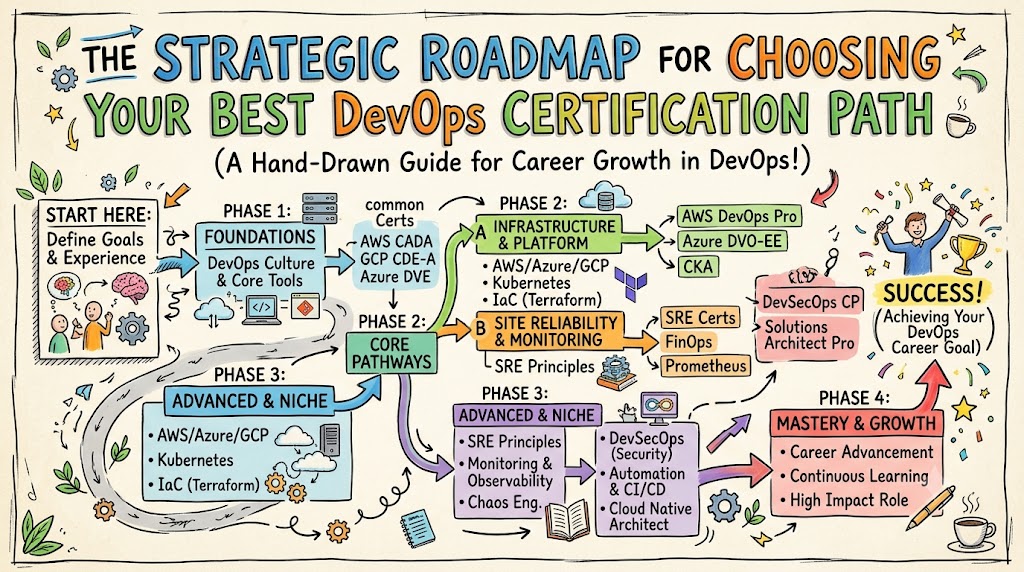
To maximize your return on investment, your certification path should align directly with your specific long-term career goals. The table below outlines tailored paths designed to take you from your current role to your target career destination.
Table 2: Role-Based Career Progression Matrix
| Career Goal | Recommended Certification Path | Why It Fits |
| Enterprise DevOps Lead | DCP ➔ Master in DevOps Engineering (MDE) ➔ CKA | Builds a strong tool foundation before advancing to enterprise-scale pipeline architecture and container cluster management. |
| Cloud Infrastructure Architect | Terraform Associate ➔ AWS Professional OR Azure Expert | Pairs cloud-agnostic Infrastructure as Code (IaC) skills with deep, vendor-specific cloud platform engineering knowledge. |
| DevSecOps Security Engineer | DCP ➔ DevSecOps Certified Professional (DSOCP) ➔ CKA | Infuses deep security principles and automated compliance scanning into core DevOps and container management workflows. |
| Site Reliability Engineer (SRE) | SRE Certified Professional ➔ Prometheus with Grafana ➔ Envoy ISTIO | Combines core SRE reliability frameworks with deep, practical skills in infrastructure monitoring and service mesh traffic control. |
| MLOps & Data Platform Architect | Master in Python ➔ Master in Machine Learning ➔ MLOps Certification | Develops core programming and data modeling skills before moving into automated training and deployment pipelines for AI systems. |
Types of DevOps Certifications
Understanding how certifications are structured helps you select the right format for your learning style and career needs.
Classification by Scope and Technology
- Vendor-Agnostic Certifications: These focus on core engineering principles, architectural patterns, and methodologies that apply anywhere, regardless of the underlying cloud provider. Examples include CKA, GitOps Certified Professional, and SRE Certified.
- Vendor-Specific Certifications: These validate your deep expertise within a particular cloud provider’s proprietary ecosystem. Examples include AWS Certified DevOps Professional and Master in Azure DevOps.
Certification Path by Role
Selecting certifications based on your professional specialization helps you build a highly targeted skill set:
- Infrastructure Automation Track:
Focuses on provisioning cloud platforms cleanly via code (e.g., Terraform Associate, AWS Certified DevOps Professional). - Cloud-Native & Containerization Track:
Specializes in building and managing modern microservices architectures (e.g., Docker DCA, Certified Kubernetes Administrator, Envoy Istio). - Data Automation & AI Operations Track:
Designed for engineers managing heavy data processing pipelines and AI deployments (e.g., Master in Python, MLOps Certification).
Common Mistakes to Avoid
- Collecting Certifications Without Hands-On Practice: Passing exams by just memorizing test dumps without actually practicing in a real terminal leaves you unprepared for technical job interviews and real-world troubleshooting.
- Skipping Foundational Concepts: Trying to learn advanced tools like Kubernetes or service meshes before mastering Linux basics, fundamental networking concepts, and simple Git workflows leads to confusion.
- Ignoring the Cultural Side of DevOps: Treating DevOps purely as a collection of software tools while ignoring core principles like team collaboration, shared responsibility, and blameless post-mortems limits your effectiveness as an engineer.
- Overcomplicating Early Projects: Trying to build massive, multi-cloud automated pipelines right from the start rather than mastering simple, single-service deployments step by step.
- Failing to Keep Your Skills Up to Date: Cloud tools and cloud-native platforms evolve quickly; failing to read updated release notes can leave you relying on outdated infrastructure practices.
Real-Life Industry Case Studies
Case 1: High-Velocity E-Commerce Zero-Downtime Deployment
A large retail website transitioned from manual server deployments to an automated pipeline verified by a Master in DevOps Engineering track. By using automated blue-green deployments, the team safely launched daily code updates during peak shopping hours with zero customer downtime.
Case 2: Financial Platform Vulnerability Mitigation
A financial services team integrated automated security scanners into their active code workflows based on DevSecOps Certified Professional guidelines. This change allowed them to catch and patch 94% of critical open-source software vulnerabilities before the code ever left developer laptops.
Case 3: Global Streaming Platform Reliability Upgrades
An international video-on-demand platform used Site Reliability Engineering methodologies to optimize their container metrics using Prometheus and Grafana. The new dashboards let operations teams spot and fix memory leaks before they could cause regional streaming outages.
Case 4: Enterprise Health System Automated Infrastructure Migration
A healthcare provider used HashiCorp Terraform modules to migrate over 300 legacy application servers to a secure public cloud. The entire complex infrastructure was spun up cleanly in a single weekend with completely standardized compliance policies.
Case 5: Predictive Logistics AI Deployment Scaling
A global shipping company used MLOps automation paths to scale their delivery route optimization models. Automated pipelines cut the time required to test, update, and deploy new predictive routing models from several weeks down to less than an hour.
Frequently Asked Questions
1. Which DevOps certification is best for absolute beginners?
The DevOps Certified Professional (DCP) or the Master in Python Programming track are excellent starting points. They focus on foundational automation principles, core scripting logic, and basic source control tools without assuming prior infrastructure experience.
2. Can I get a DevOps job by only holding certifications?
Certifications provide structured validation and help get your resume past initial HR screenings, but they must be paired with an active portfolio of hands-on projects. Building real, working deployment pipelines and infrastructure scripts is what ultimately lands the job.
3. How long does it typically take to prepare for the Certified Kubernetes Administrator (CKA) exam?
For engineers who already understand container basics, it typically takes 6 to 12 weeks of consistent, hands-on terminal practice to prepare. Because the CKA is a fully practical, performance-based exam, getting comfortable troubleshooting live clusters in real time is essential.
4. What is the main difference between vendor-agnostic and vendor-specific certifications?
Vendor-agnostic certs (like CKA or Terraform Associate) teach open-source tools and principles that apply across any cloud environment. Vendor-specific certs (like AWS or Azure DevOps) focus deeply on optimizing workflows within that specific provider’s ecosystem.
5. Why is Python programming considered a core requirement for DevOps careers?
Python is the primary language used for writing infrastructure scripts, cloud automation workflows, and data management pipelines. It is highly versatile, easy to read, and supported natively by almost every major cloud provider and automation tool.
6. How does a DevSecOps certification differ from a standard DevOps certification?
Standard DevOps tracks focus on the speed and efficiency of building and deploying software. DevSecOps certifications focus heavily on inserting automated security checks, code analysis tools, and compliance safeguards directly into those deployment pipelines.
7. What role do Prometheus and Grafana play in modern SRE paths?
Prometheus acts as the time-series data engine that collects operational performance metrics from your applications and infrastructure. Grafana serves as the visual layer, turning those metrics into clean, live dashboards that help SRE teams monitor system health and catch issues early.
8. Is it worth getting a Docker certification now that Kubernetes is so dominant?
Yes, because Kubernetes is a container orchestrator—it manages container images built by runtimes like Docker. Understanding how to build efficient, secure, and lightweight container images is a core prerequisite for managing them inside a Kubernetes cluster.
9. What exactly is GitOps, and why is it growing so quickly?
GitOps is a practice where Git repositories serve as the single, declarative source of truth for your infrastructure configurations. When you update your code in Git, automated controllers safely sync your live cloud environments to match, making deployments highly auditable and easy to roll back.
10. How difficult is the AWS Certified DevOps Professional exam compared to associate-level exams?
It is significantly more difficult. Associate exams focus on identifying and configuring individual AWS services, while the Professional exam tests your ability to design complex, multi-account automation patterns, disaster recovery strategies, and continuous delivery pipelines at enterprise scale.
11. Do DevOps certifications expire, and how do I renew them?
Most major cloud and container certifications are valid for 2 to 3 years. You can renew them either by passing the updated version of the exam or by earning a higher-level specialty certification within that same technology path.
12. How does MLOps differ from traditional DevOps workflows?
Traditional DevOps focuses on deploying stable application code. MLOps manages a shifting three-part ecosystem: the application code, the data models, and the massive data sets used to train them, which requires specialized automation for model versioning and retraining.
Conclusion
Building a successful career in modern tech requires a commitment to continuous learning and clear validation of your skills. Whether you are an absolute beginner learning the ropes of systems automation or an experienced engineer moving into advanced SRE, GitOps, or MLOps tracks, pursuing a structured certification path keeps your learning efficient and targeted.
By combining deep theoretical knowledge with consistent, practical project work, you build the verfied expertise that modern enterprise teams actively look for. To choose your learning path, explore comprehensive course options, and start building your hands-on infrastructure portfolio, head over to the BestDevOps Certification Resource Page to begin planning your next career milestone today.