
Introduction
In the current digital landscape, IT environments have transitioned from static, predictable monoliths to highly dynamic, distributed systems. With the widespread adoption of cloud-native architectures, Kubernetes, and microservices, the volume of telemetry data—logs, metrics, and traces—has reached an overwhelming scale. Enterprises often find themselves in a reactive cycle, where IT teams are flooded with thousands of daily alerts, struggling to identify the actual root cause of service disruptions.
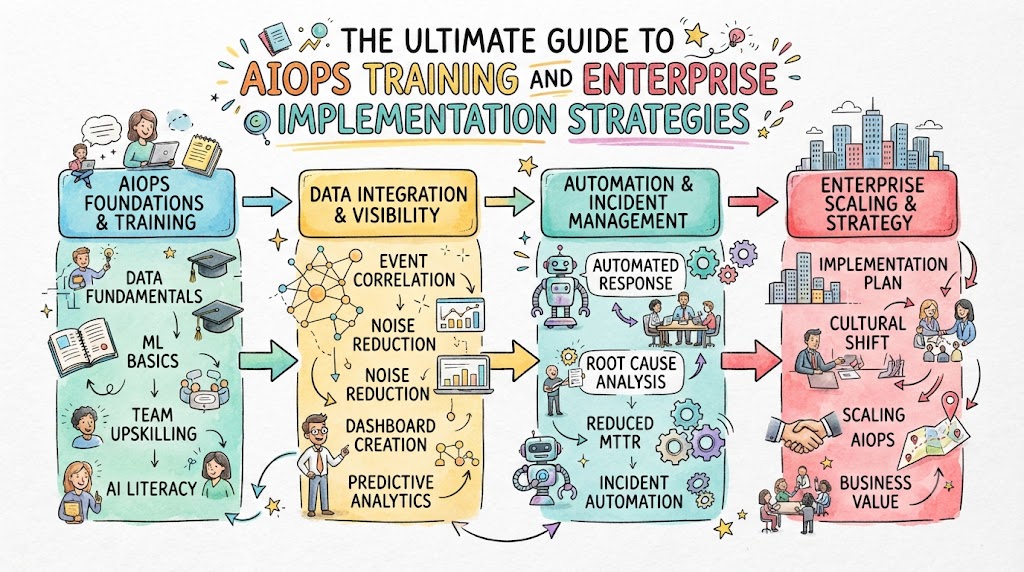
To break this cycle, organizations are turning toward Artificial Intelligence for IT Operations (AIOps). AIOps is not merely a tool upgrade; it is a fundamental shift in how teams manage infrastructure, reduce toil, and ensure reliability. By leveraging machine learning to process massive datasets, AIOps provides the actionable intelligence required to automate incident resolution and optimize performance. For professionals looking to lead this shift, gaining formal expertise through AIOpsSchool is a critical step in mastering these high-demand competencies. As systems grow more complex, the ability to synthesize data into meaningful insights will define the next generation of successful IT operations.
Featured Snippet
What Is AIOps?
AIOps, or Artificial Intelligence for IT Operations, combines big data and machine learning to automate IT operations processes. It ingests large volumes of telemetry data from diverse sources to perform event correlation, anomaly detection, and automated root cause analysis, ultimately helping teams move from reactive firefighting to proactive, intelligent operations management.
Understanding AIOps
What Is Artificial Intelligence for IT Operations?
At its core, AIOps is the application of AI and ML to improve the efficiency, stability, and speed of IT service delivery. It bridges the gap between massive data generation and human decision-making capacity.
Why Traditional IT Operations Are No Longer Enough
Traditional monitoring systems rely on static thresholds. While effective for simple environments, they fail in elastic cloud environments where “normal” baseline performance changes by the minute. Manually configuring alerts for every microservice is unsustainable, leading to catastrophic alert fatigue.
How AI and Machine Learning Improve Operations
AIOps engines utilize pattern recognition to distinguish between background noise and genuine system threats. By learning the “behavior” of an application over time, these systems can predict potential failures before they impact users, allowing engineers to address issues during standard business hours.
Evolution from Monitoring to Intelligent Operations
| Traditional Operations | AIOps-Driven Operations |
| Static Thresholds | Dynamic/Adaptive Baselining |
| Manual Troubleshooting | Automated Root Cause Analysis |
| High Alert Fatigue | Intelligent Alert Correlation |
| Reactive Incident Response | Proactive/Predictive Resolution |
Why AIOps Skills Are Becoming Essential
The modern IT stack is now a complex web of interconnected services. As companies scale, the “human-in-the-loop” model for incident response becomes a bottleneck. Organizations are prioritizing candidates who possess AIOps expertise because it directly correlates to reduced mean time to resolution (MTTR) and higher operational stability. For SREs and DevOps professionals, these skills represent the transition from managing infrastructure to orchestrating intelligent systems.
AIOps Certification Explained
What Is an AIOps Certification?
An AIOps certification validates an individual’s proficiency in deploying, managing, and optimizing AI-driven operational workflows. It covers the technical intersection of data science, observability, and infrastructure management.
Who Should Pursue AIOps Certification?
- DevOps/SRE Engineers: To automate toil and improve reliability.
- Cloud Engineers: To manage complex cloud-native architectures.
- Monitoring Specialists: To evolve legacy alerting into intelligent observability.
- IT Managers: To lead strategic AIOps adoption and transformation initiatives.
AIOps Engineer Certification Path
| Level | Skills | Outcome |
| Beginner | Monitoring Basics, Data Literacy | Foundational AIOps Concepts |
| Intermediate | ML Basics, Observability, Python | Practical Tool Integration |
| Advanced | Predictive Analytics, Scaling, Strategy | Enterprise AIOps Architecture |
AIOps Engineer Career Roadmap
Required Technical Skills
A successful path requires a blend of traditional operations knowledge and new-age data skills:
- Infrastructure: Linux, Networking, Kubernetes, Cloud (AWS/Azure/GCP).
- Programming: Python for data manipulation and automation scripts.
- Observability: Deep knowledge of logs, metrics, traces, and OpenTelemetry.
- AIOps Specifics: Event correlation, anomaly detection, and predictive maintenance.
Learning Sequence
- Master core monitoring and observability fundamentals.
- Develop proficiency in at least one scripting language (Python is preferred).
- Gain hands-on experience with OpenTelemetry and modern observability stacks.
- Enroll in structured AIOps training to synthesize these skills into production-ready workflows.
AI Observability Training
What Is AI Observability?
It is the practice of gaining deep visibility into the internal state of a system by examining its external outputs, enhanced by AI to provide context to the data.
Monitoring vs. Observability
| Monitoring | Observability |
| Tells you if the system is broken | Tells you why it is broken |
| Focuses on known-unknowns | Explores unknown-unknowns |
| Dashboard-based | Query-driven and exploratory |
AIOps for SRE and DevOps Engineers
In a high-velocity environment, AIOps acts as a force multiplier for SREs. By utilizing intelligent event correlation, AIOps can group 500 individual alerts into a single “incident,” effectively eliminating alert fatigue. This allows engineers to focus on high-impact projects rather than chasing false positives.
Enterprise AIOps Consulting and Implementation
Implementation Lifecycle
Successful adoption follows a rigorous framework:
- Assessment: Evaluating current maturity and pain points.
- Design: Defining success metrics and architectural needs.
- Tool Selection: Matching the right AI engines to the stack.
- Integration: Connecting data sources via OpenTelemetry.
- Optimization: Refining ML models for better accuracy.
Frequently Asked Questions (FAQ)
1. What is AIOps Certification? AIOps Certification is a professional credential that validates an individual’s technical expertise in applying artificial intelligence and machine learning to IT operations. It confirms that a professional can design, implement, and manage intelligent systems that automate anomaly detection, event correlation, and incident resolution.
2. Who should learn AIOps? AIOps is essential for any professional involved in the lifecycle of digital services. This includes DevOps Engineers, Site Reliability Engineers (SREs), Cloud Engineers, IT Operations Managers, and Monitoring Specialists who want to transition from manual “firefighting” to automated, proactive system management.
3. What skills are required for AIOps Engineers? Successful AIOps Engineers require a hybrid skill set. You need a strong foundation in IT infrastructure (Linux, Networking, Kubernetes), proficiency in scripting languages like Python for data automation, a deep understanding of observability practices, and the ability to interpret machine learning insights generated by monitoring platforms.
4. How does AIOps help DevOps teams? AIOps acts as a force multiplier for DevOps by eliminating “alert fatigue.” Instead of manually reviewing thousands of logs, DevOps teams use AIOps to automatically correlate events and identify root causes, allowing them to focus on feature development and continuous delivery rather than reactive maintenance.
5. What is AI Observability? AI Observability is the practice of combining traditional observability (logs, metrics, and traces) with AI-driven analytics. It goes beyond simple monitoring to provide deep, contextual insights into the internal state of a distributed system, enabling teams to understand complex performance issues that traditional dashboards miss.
6. What is OpenTelemetry? OpenTelemetry is an open-source observability framework that provides a standardized way to collect, generate, and export telemetry data (logs, metrics, and traces). It is the backbone of modern AIOps because it ensures that data is consistent and interoperable across different cloud-native tools.
7. How long does it take to learn AIOps? Learning AIOps is a progressive journey. With a solid foundation in IT operations, professionals can typically gain core competency through structured training programs in several weeks. The time required depends on the depth of the curriculum, with advanced architecture and implementation skills taking additional time to master.
8. What are AIOps Implementation Services? These are expert-led services provided by consultants to help organizations integrate AI into their existing IT environments. These services include assessing operational maturity, choosing the right AI-powered tools, mapping data pipelines, and building a roadmap for long-term automation and reliability.
9. Is AIOps a good career choice? Absolutely. As enterprises migrate to complex, distributed cloud architectures, the demand for professionals who can manage these systems via AI-driven automation is skyrocketing. It is one of the most future-proof career paths for those currently working in infrastructure and operations.
10. What is the future of AIOps? The future of AIOps is “Autonomous Operations.” This involves moving beyond predictive alerting to self-healing infrastructure, where AI systems not only identify potential issues but automatically execute remediation workflows—such as scaling resources or restarting services—without human intervention.
FINAL SUMMARY
The transition to AIOps is inevitable for any organization scaling its digital infrastructure. By integrating AI into monitoring and incident response, teams can eliminate the noise of modern operations and focus on delivering business value. From reducing downtime to enhancing team morale, the benefits are transformative. For those ready to lead this change, specialized training and certification provide the roadmap to becoming an authority in the field. Explore the comprehensive programs available at AIOpsSchool to start your journey toward mastering the future of AI-powered IT operations.