
Introduction
Deciding to start or expand a family through assisted reproduction is one of the most significant choices you can make. If you are currently sitting at this crossroads, you likely already know that researching fertility care online can feel like stepping into an unfamiliar maze. Between complex medical jargon, fluctuating price tags, and countless clinic reviews, it is entirely normal to feel overwhelmed. Whether you are in the very early stages of exploring your biological timeline or actively looking to partner with a specialized care team, having access to clear, structured, and compassionate guidance makes all the difference. Platforms like IVFHospitalsNow.com serve as invaluable discovery tools designed to help patients make sense of fertility care, breaking down treatment workflows, clinic evaluation factors, and cost considerations without the corporate smoke and mirrors.
What Is IVF Treatment?
In-vitro fertilization—widely known as IVF—is a sophisticated form of assisted reproductive technology (ART) designed to help individuals and couples overcome fertility hurdles or prevent genetic conditions. At its core, IVF bypasses natural conception by orchestrating the process in a specialized laboratory environment. Mature eggs are retrieved from the ovaries and combined with sperm to achieve fertilization. Once the resulting embryos develop and reach a specific stage of growth, one or more are transferred directly into the uterus with the hope of successful implantation and a healthy pregnancy. It is important to understand that IVF is never a one-size-fits-all medical protocol. Your fertility specialist will custom-tailor every step based on your age, diagnostic blood work, underlying reproductive health, and previous medical history. Because every human body responds uniquely, a comprehensive consultation with a licensed reproductive endocrinologist is always the mandatory starting point.
Understanding the IVF Treatment Process in Detail
Demystifying what happens behind the clinic doors can alleviate a tremendous amount of anxiety. Here is a detailed look at how a standard IVF cycle unfolds from start to finish:
1. Initial Fertility Assessment and Diagnostics
Before any medication is prescribed, your clinic will run a thorough baseline evaluation. This typically includes hormone panels (such as AMH, FSH, and estradiol), pelvic ultrasounds to check antral follicle counts, and a comprehensive semen analysis for male-factor evaluation. These diagnostics allow the medical team to pinpoint the exact root causes of any fertility roadblocks.
2. Ovarian Stimulation
Normally, a person releases one mature egg per month. During IVF, patients undergo a controlled ovarian stimulation (COS) phase lasting roughly 8 to 14 days. This involves self-administering daily hormone injections (gonadotropins) to encourage multiple follicles to mature simultaneously. Frequent monitoring appointments—consisting of transvaginal ultrasounds and blood draws—allow doctors to track follicle growth and fine-tune your medication dosage in real time.
3. Trigger Shot and Egg Retrieval
Once the follicles reach optimal size, a final “trigger injection” is administered precisely timed to mature the eggs just before collection. Egg retrieval is a minor surgical procedure performed under light intravenous (IV) sedation. Using ultrasound guidance, a thin needle is passed through the vaginal wall to gently aspirate fluid from the follicles, collecting the mature eggs. The procedure usually takes less than 30 minutes, though patients rest in recovery for a short time afterward.
4. Fertilization and Embryo Culture
Immediately following retrieval, the eggs are handed over to the embryology laboratory. Fertilization can happen via conventional insemination (placing sperm and eggs together in a dish) or through ICSI (injecting a single sperm directly into an egg). Over the next 3 to 6 days, the embryology team monitors cell division, grading the embryos as they develop toward the blastocyst stage.
5. Embryo Transfer
The transfer is a quick, painless procedure resembling a routine Pap smear. A thin, flexible catheter carrying the selected embryo is gently guided through the cervix into the uterine cavity. If you have remaining high-quality embryos, they can be cryopreserved (frozen) for future use.
6. The Two-Week Wait and Pregnancy Test
Approximately 10 to 14 days after the embryo transfer, you will return to the clinic for a beta-hCG blood test. This definitive lab work measures hormone levels to confirm whether implantation and pregnancy have successfully occurred.
IVF Treatment Cost and What It Includes
Financial planning is frequently a top priority for patients. The overall IVF treatment cost can vary widely based on your location, clinic fees, and personal medical needs. To evaluate financial estimates accurately, you must know what is actually built into a baseline quote:
- Initial doctor consultations, physical exams, and treatment planning sessions
- Diagnostic blood work and baseline infectious disease screenings
- Clinical monitoring visits (ultrasounds and hormone labs throughout stimulation)
- The egg retrieval procedure, including surgical and anesthesia fees
- Laboratory fertilization, culture, and embryology services
- The embryo transfer procedure itself
- Post-transfer follow-up care and confirmation blood tests
Always request a transparent, itemized fee schedule from any clinic you consider to identify what is covered and what triggers out-of-pocket extras.
Factors That Can Affect IVF Treatment Cost
No two pricing invoices look identical because no two medical journeys are identical. Several clinical and lifestyle variables can cause your ultimate expenses to shift:
- Age and Medical Diagnosis: Specific underlying conditions may necessitate higher medication doses or specialized lab protocols.
- Prescription Medication Requirements: Fertility drugs fluctuate in price and represent a substantial portion of your overall budget.
- Number of Cycles: Some patients require more than one retrieval or transfer cycle to achieve a live birth.
- Advanced Laboratory Add-ons: Techniques like Pre-implantation Genetic Testing (PGT) or specialized sperm preparation add to baseline lab fees.
- Cryopreservation and Storage Fees: Freezing and annually storing eggs, sperm, or embryos involves ongoing maintenance costs.
- Geographical Location: Clinics situated in high-cost-of-living metropolitan areas or international destinations carry differing travel and logistical expenses.
Understanding IVF Success Rates
When individuals research reproductive care, they inevitably review IVF success rates. These statistics indicate the percentage of treatment cycles that result in a clinical pregnancy or live birth. However, interpreting these numbers requires careful context. Success rates are heavily influenced by:
- Age: Maternal age is the single most powerful predictor of egg quality and treatment success.
- Diagnostic History: The underlying reason for seeking treatment plays a significant role in expected outcomes.
- Embryological Standards: The technological sophistication of the lab and the skill of the embryologists heavily impact developmental success.
- Previous Treatment Cycles: Past history provides insight into how an individual’s body responds to hormonal protocols.
Think of success rates as historical benchmarks rather than personal guarantees. Always ask clinics how they calculate their metrics and whether their reported patient demographics match your specific age and medical profile.
How to Compare Fertility Clinics
Choosing where to place your trust is a massive decision. To effectively compare fertility clinics, look past flashy marketing campaigns and evaluate the operational pillars that genuinely impact care quality:
- The board certifications and hands-on experience of the reproductive endocrinologists.
- The technological sophistication, air filtration systems, and clean-room standards of the embryology lab.
- Transparent, honest pricing structures without hidden financial surprises.
- Clear, age-disaggregated success-rate data.
- Responsive communication, empathy, and accessible support from the nursing and care coordination teams.
What to Look for When Choosing IVF Clinics
When narrowing down your shortlist of IVF clinics, look for a team that treats you like a partner rather than a number. A trustworthy medical center will sit down with you, explain your statistical odds realistically, outline potential risks, and never pressure you into purchasing unnecessary add-ons or packages.
IVF Abroad: Important Things to Consider
Many patients explore IVF abroad as a viable pathway to access specialized care or manage overall expenses. While traveling internationally for medical treatment offers distinct advantages, it also introduces complex logistical puzzles that demand meticulous planning:
- Verifying international clinic accreditations, government health licenses, and doctor credentials.
- Managing extended travel timelines, visa requirements, and local lodging.
- Navigating potential language barriers and ensuring your medical records transfer smoothly across borders.
- Establishing pre-treatment monitoring and post-treatment follow-up care with a local physician before you depart.
- Factoring in currency exchange fluctuations, travel insurance, and emergency contingency funds.
Understanding IVF Cost by Country
When analyzing the IVF cost by country, price differences typically stem from local labor markets, healthcare laws, and pharmaceutical pricing structures. While some nations feature much lower base clinic fees, you must calculate the big picture. Factor in international airfare, weeks of local accommodation, medication procurement abroad, and post-treatment checkups to determine your true total expense.
Egg Freezing and Fertility Preservation
Egg freezing (oocyte cryopreservation) has emerged as a powerful option for people wanting to safeguard their reproductive potential for the future. Whether someone is delaying family building for career or personal reasons, or facing medical treatments (such as oncology care) that threaten fertility, the process offers newfound control over biological timelines. The procedure mimics the first half of an IVF cycle—controlled ovarian stimulation followed by egg retrieval—after which the mature eggs are flash-frozen using an advanced technique called vitrification. While it offers wonderful flexibility, keep in mind that success depends heavily on the age at which the eggs were frozen.
Understanding ICSI Treatment
If your doctor mentions ICSI treatment (Intracytoplasmic Sperm Injection), there is no need to be alarmed. It is an advanced micromanipulation technique frequently performed alongside standard IVF. In a traditional IVF setup, eggs and sperm are placed together in a culture dish to let nature take its course. With ICSI, an embryologist selects a single, highly motile, morphologically normal sperm under a high-powered microscope and injects it directly into the center of a mature egg. It is routinely recommended for severe male-factor infertility or previous fertilization failures, though it does not guarantee pregnancy on its own.
Exploring Different Fertility Treatment Options
IVF is merely one tool in a broad reproductive toolkit. Depending on your specific health profile and diagnostic results, a specialist might suggest several different fertility treatment options:
- Oral or Injectable Fertility Medications: Hormonal therapies designed to stimulate or regulate ovulation.
- Intrauterine Insemination (IUI): Placing washed, concentrated sperm directly into the uterine cavity right around the time of ovulation.
- Conventional IVF & ICSI: Laboratory-assisted fertilization methods.
- Egg and Embryo Cryopreservation: Long-term storage of genetic material for future family planning.
- Third-Party Reproduction: Utilizing donor eggs, donor sperm, or gestational carriers when medically indicated.
Fertility Treatment Options at a Glance
| Fertility Treatment Option | General Purpose | Important Consideration |
| Fertility Medications | Stimulate or regulate ovulation cycles | Requires regular monitoring via blood tests and ultrasounds |
| Intrauterine Insemination (IUI) | Places prepared sperm directly into the uterus | Less invasive than IVF; success rates vary by diagnosis |
| In-Vitro Fertilization (IVF) | Combines eggs and sperm in a lab; transfers resulting embryo | Involves multiple stages, including ovarian stimulation and egg retrieval |
| ICSI Treatment | Injects a single sperm directly into a mature egg | Often used for male factor infertility or previous fertilization challenges |
| Egg Freezing | Preserves unfertilized oocytes for future family planning | Success depends significantly on the age at the time of freezing |
| Embryo Freezing | Stores created embryos via cryopreservation for later transfer | Allows future transfer cycles without repeating egg retrieval |
| Donor-Assisted Treatment | Utilizes donor eggs, sperm, or embryos | Involves additional legal, ethical, and counseling considerations |
How to Prepare for a Fertility Clinic Consultation
Walking into your initial appointment fully prepared can save you immense time, reduce stress, and ensure all your questions are answered. Be sure to bring:
- A written summary of your personal and family medical histories.
- Copies of any previous fertility lab work, hormone panels, or imaging reports.
- A comprehensive list of all prescription medications, vitamins, and supplements you take daily.
- A notebook dedicated to logging answers regarding treatment timelines, protocols, and financial estimates.
Questions to Ask Before Choosing a Fertility Clinic
Before you sign any financial agreements or treatment contracts, put these essential questions to your prospective clinic:
- What underlying factors do you believe are contributing to our fertility challenges?
- What specific treatment protocol do you recommend for us, and what is the clinical rationale behind it?
- What is our all-in financial estimate, including medications, anesthesia, and lab add-ons?
- How does your clinic calculate its success rates, and do those numbers reflect patients in our exact age bracket?
- What quality control measures and air filtration standards do you maintain in your embryology lab?
- Will I have a dedicated care coordinator, or will I see rotating physicians throughout my cycle?
Common Mistakes Patients Should Avoid When Comparing Fertility Care
It is easy to misstep when navigating a high-stakes medical process. Try to avoid these common pitfalls:
- Selecting a clinic purely based on the cheapest baseline sticker price without checking what is excluded.
- Reviewing success rates in a vacuum without analyzing patient demographics and diagnostic definitions.
- Forgetting to budget for out-of-pocket expenses like medication markups, anesthesia fees, and storage renewals.
- Assuming every patient follows a standardized, cookie-cutter medical protocol.
- Relying solely on anonymous online forum reviews rather than verifying medical credentials and clinical data.
Key Factors in Clinic Selection
| Clinic Comparison Factor | What to Check | Why It Matters |
| Treatment Cost | Itemized pricing and package inclusions | Prevents unexpected financial surprises during treatment |
| Success-Rate Reporting | Age-specific data and transparent calculation methods | Provides a realistic baseline of clinic performance |
| Specialist Expertise | Board certifications and reproductive endocrinology experience | Ensures care is guided by qualified professionals |
| Laboratory Facilities | Air quality controls, equipment standards, and embryology credentials | The lab environment directly impacts embryo development |
| Treatment Options | Availability of advanced procedures (ICSI, PGT, freezing) | Ensures your clinic can adapt your protocol if needed |
| Follow-Up Care | Support systems after positive or negative test results | Crucial for emotional well-being and planning next steps |
| Location | Proximity to your home or accommodation arrangements | Minimizes stress during frequent monitoring visits |
| Additional Costs | Fees for anesthesia, storage, and specialized lab work | Contributes to accurate budgeting for your cycle |
Who Can Benefit From Fertility Information Platforms?
Couples Exploring IVF
Couples taking their very first steps can use structured educational guides to demystify complex medical processes and walk into consultations feeling confident.
People Comparing Fertility Clinics
Readers evaluating care providers can use objective comparison metrics to look past marketing hype and focus on clinical reality.
Patients Researching Treatment Costs
Individuals can learn how to dissect financial estimates, separate medication costs from clinic fees, and budget realistically.
People Considering IVF Abroad
Those curious about international care can explore the logistical, legal, and medical realities before booking travel arrangements.
People Exploring Fertility Preservation
Anyone looking into egg freezing can find clear, unvarnished explanations of how timing and biology impact long-term outcomes.
People Learning About Different Fertility Treatments
Readers can survey the full landscape of assisted reproduction to understand their options before speaking with a professional.
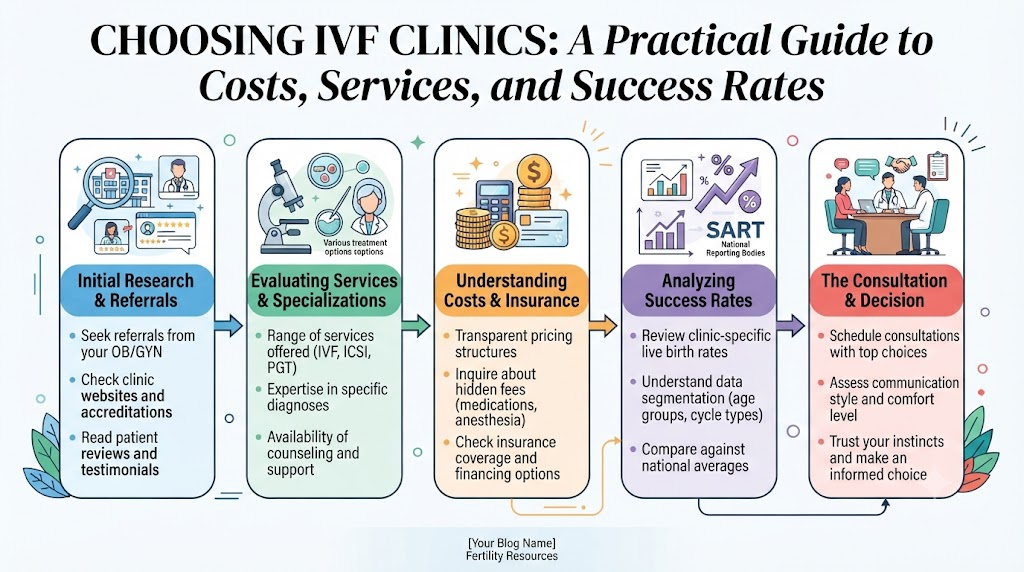
Step-by-Step Guide to Researching Fertility Treatment
Step 1: Understand Your Fertility Concerns
Collect your baseline health history and outline your personal family-building timeline.
Step 2: Learn About Available Treatment Options
Familiarize yourself with the clinical differences between ovulation-inducing drugs, IUI, IVF, and preservation.
Step 3: Research Suitable Fertility Clinics
Compile a list of local or international medical centers with strong clinical credentials and transparent reputations.
Step 4: Compare Treatment Costs
Request transparent, itemized quotes to see what your care will actually cost from start to finish.
Step 5: Review IVF Success-Rate Information
Examine performance data with an eye toward patient age, diagnostic context, and reporting transparency.
Step 6: Check Clinic and Laboratory Details
Confirm the technical standards of the lab and the board certifications of the attending physicians.
Step 7: Ask Questions During Your Consultation
Bring your checklist of targeted questions to ensure all your personal concerns are addressed directly.
Step 8: Make a Decision With Qualified Medical Guidance
Partner with your chosen specialist to build a customized, patient-centered care plan.
Common Challenges When Researching IVF Treatment
Patients frequently bump into a few predictable roadblocks during their research phase:
- Data Overload: Drowning in a sea of conflicting medical blogs and forum opinions.
- Hidden Fees: Discovering that advertised package prices exclude critical medication or lab add-on expenses.
- Interpreting Stats: Struggling to make sense of varying success-rate metrics reported across different clinics.
- Logistical Stress: Sorting out international travel arrangements, language hurdles, and medical record transfers.
Best Practices for Fertility Clinic Research
- Consult more than one clinic to compare different medical philosophies, treatment styles, and bedside manners.
- Look past cheap marketing prices to evaluate overall clinical and laboratory quality.
- Always secure financial quotes in writing with a comprehensive, itemized breakdown.
- Review success data critically and ask questions about patient demographics.
- Prioritize emotional comfort, transparency, and open lines of communication with your care team.
- Always bring your research findings to a qualified reproductive endocrinologist for clinical validation.
How to Evaluate Online Fertility Information Responsibly
The internet is full of opinions, but reproductive health requires rigorous facts. Keep these guiding rules in mind:
- Rely on data backed by recognized medical boards, government health bodies, or peer-reviewed journals.
- Make sure the information is up-to-date and reflects modern medical standards.
- Run away from any website or clinic guaranteeing a 100% success rate or a “guaranteed baby.”
- Remember that educational articles never replace a one-on-one medical consultation with a licensed physician.
Frequently Asked Questions
1. What factors affect IVF treatment cost?
Prices are driven by your geographic location, medication requirements, lab add-on procedures, diagnostic testing, and the number of cycles you undergo.
2. How should patients understand IVF success rates?
Treat success rates as historical guidelines reflecting past patient groups rather than individual guarantees for your specific cycle.
3. What should people check when choosing IVF clinics?
Pay close attention to doctor credentials, lab air quality and technology, cost transparency, and how clearly the team communicates with you.
4. How can patients compare fertility clinics?
Focus on objective metrics like specialist experience, lab standards, transparent pricing sheets, and patient support services.
5. What should patients consider before choosing IVF abroad?
Weigh international medical standards, travel stress, language hurdles, continuity of follow-up care, and total out-of-pocket expenses.
6. Why can IVF cost by country vary?
Local economic factors, government healthcare subsidies, labor wages, and pharmaceutical pricing all cause costs to shift across borders.
7. What is egg freezing?
It is a preservation process where mature eggs are retrieved and flash-frozen via vitrification so they can be thawed and used in the future.
8. What is ICSI treatment?
ICSI is a lab procedure where a single sperm is injected directly into an egg to help achieve fertilization during an IVF cycle.
9. What fertility treatment options may be available?
Options range from ovulation-stimulating drugs and IUI to conventional IVF, ICSI, egg freezing, and donor-assisted care.
10. What questions should patients ask before starting IVF treatment?
Ask about expected timelines, recommended medication protocols, total costs, potential medical risks, and what happens if an initial cycle is unsuccessful.
Conclusion
Embarking on a fertility journey takes immense courage, patience, and reliable guidance. By understanding the IVF workflow, looking past surface-level pricing, and evaluating clinics with a critical, informed eye, you can take control of your reproductive healthcare decisions. While platforms like IVFHospitalsNow.com offer helpful educational tools and discovery pathways to kickstart your research, every personal story is unique. Always partner with a qualified fertility specialist to discuss your medical history, explore your options, and build a customized care plan tailored specifically to your family’s future.