
Introduction
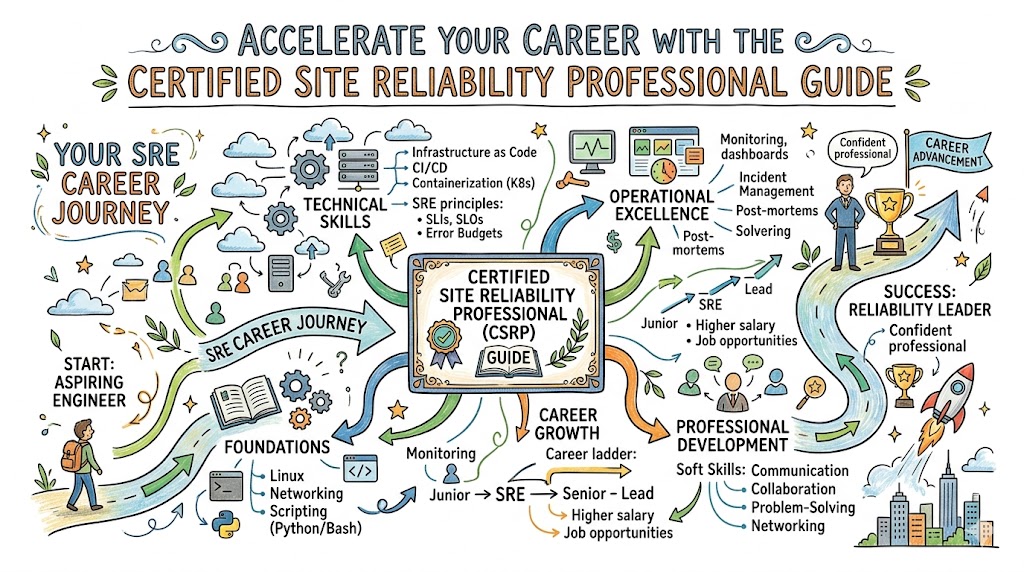
In today’s cloud-native ecosystem, mastering infrastructure stability is no longer optional—it is a core requirement for any high-performing engineer. The Certified Site Reliability Professional offers a structured pathway for those looking to refine their approach to system reliability. This guide is tailored for software engineers, DevOps practitioners, and platform architects who want to formalize their operational expertise. By leveraging the curriculum provided by sreschool, professionals can gain the technical depth needed to manage large-scale distributed systems. Understanding these concepts is essential for making informed career moves in a competitive global market. We will walk through how this certification helps you bridge the gap between development cycles and production-grade stability, providing you with a clear roadmap. Much like specialized learning at [aiopsschool], this certification acts as a milestone in your professional growth.
What is the Certified Site Reliability Professional?
The Certified Site Reliability Professional is a rigorous credential that validates an engineer’s capability to maintain high-availability systems. It exists to provide a clear, standardized framework for operational excellence, shifting the focus from reactive firefighting to proactive system design. The program prioritizes practical, production-oriented knowledge, teaching engineers how to balance feature velocity with system reliability. It aligns with enterprise best practices by focusing on observability, error budgets, and the automation of manual toil. By understanding these concepts, engineers can help their organizations navigate the complexities of modern, cloud-native infrastructure with greater confidence and efficiency.
Who Should Pursue Certified Site Reliability Professional?
This certification is designed for a broad spectrum of professionals, ranging from software engineers aiming to move into infrastructure to seasoned SREs looking to formalize their experience. Cloud engineers, security practitioners, and data specialists will find the curriculum directly applicable to their day-to-day challenges in managing distributed environments. Engineering managers who oversee technical teams will also benefit from the program, as it provides a standardized way to communicate reliability goals. Whether you are a professional in India’s growing tech sector or working in a global enterprise, this certification offers the foundational knowledge and advanced architectural insights required to excel in modern platform engineering.
Why Certified Site Reliability Professional
As enterprise environments become increasingly complex, the ability to manage system reliability has become a highly sought-after skill set. This certification provides long-term value because it focuses on the fundamental principles of system design rather than fleeting trends or specific proprietary tools. It helps engineers stay relevant by providing a durable skill set that remains applicable as technology stacks evolve. The investment in this certification translates to a deeper understanding of system behavior, which is essential for any professional aiming for senior or principal-level roles. It is a strategic move that enhances your profile, ensuring you are prepared for the reliability challenges of the future.
Certified Site Reliability Professional Certification Overview
Delivered through the official program at and hosted on sreschool, this certification is built on a modular, assessment-led structure. It covers everything from the core definitions of service level objectives to advanced incident management strategies. The program is designed to be highly practical, ensuring that every concept learned can be applied to real-world production challenges. By completing this program, you gain a recognized validation of your skills, proving that you have met the industry’s rigorous standards for reliability engineering and operational maturity.
Certified Site Reliability Professional Certification Tracks & Levels
The certification is categorized into foundation, professional, and advanced tiers, allowing you to advance at your own pace. Foundation levels establish the basics, such as defining SLOs and identifying sources of toil, while the professional level focuses on architectural decisions and incident lifecycle management. Advanced levels are tailored for those tackling complex system scaling and organizational reliability culture. Specialization tracks are also available, including paths for those focusing on DevOps, FinOps, or AIOps. This structure ensures that your learning path is directly aligned with your current job responsibilities and your future career trajectory.
Complete Certified Site Reliability Professional Certification Table
| Track | Level | Who it’s for | Prerequisites | Skills Covered | Recommended Order |
|---|---|---|---|---|---|
| SRE Core | Foundation | Junior Engineers | Cloud Basics | Metrics, SLIs, SLOs | 1 |
| SRE Ops | Professional | SREs/SysAdmins | Foundation | Incident Handling | 2 |
| Architecture | Advanced | Senior/Architects | Professional | Scaling, Resiliency | 3 |
| Expert | Mastery | Principal/Leads | Advanced | System Strategy | 4 |
Detailed Guide for Each Certified Site Reliability Professional Certification
Certified Site Reliability Professional – Foundation Level
What it is This module introduces the foundational SRE mindset, focusing on how reliability is measured and managed in a modern production environment. It defines the core tenets that keep services stable.
Who should take it Aspiring SREs and software engineers who interact with production infrastructure and want to understand how to define and track service reliability.
Skills you’ll gain
- Ability to define effective SLIs and SLOs.
- Techniques for quantifying and reducing manual toil.
- Insight into the error budget philosophy.
Real-world projects you should be able to do
- Setting up a basic alerting system based on error budgets.
- Auditing a manual process for automation potential.
- Drafting a service level agreement for a prototype application.
Preparation plan
- 7–14 days: Focus on core theory and understanding SRE terminology.
- 30 days: Engage in hands-on labs that mimic real-world monitoring setups.
- 60 days: Review case studies and prepare for the final assessment with practice scenarios.
Common mistakes Focusing too much on the “how” of specific monitoring tools instead of the “why” of the reliability principles being taught.
Best next certification after this
- Same-track option: Certified Site Reliability Professional – Professional Level
- Cross-track option: DevOps Foundation
- Leadership option: Team Lead in SRE
Choose Your Learning Path
DevOps Path
The DevOps track helps you integrate reliability practices into your CI/CD pipelines. You will learn how to ensure that automated deployments do not degrade service availability, creating a seamless bridge between coding and production stability.
DevSecOps Path
This path combines reliability with security, focusing on how to maintain a stable service while implementing automated security patches and compliance checks. It is ideal for those who manage critical, public-facing applications.
SRE Path
The core SRE track is the most comprehensive, covering everything from design to emergency response. It is the gold standard for engineers dedicated to the science of maintaining uptime in large, complex distributed systems.
AIOps Path
The AIOps track teaches you to use machine learning to gain deeper insights into your infrastructure. You will focus on automated log analysis and intelligent alerting, reducing noise and focusing on actual service threats.
MLOps Path
This path focuses on the reliability of machine learning models. It covers how to monitor model performance, data drift, and the infrastructure needed to keep AI services consistently reliable for end-users.
DataOps Path
DataOps focuses on the reliability of your data infrastructure. You will learn how to maintain stable data pipelines, ensuring that your analytical systems remain accurate and available for business decision-making.
FinOps Path
The FinOps track is essential for those who need to balance reliability with budget constraints. You will learn how to optimize cloud resource usage without negatively impacting the performance or availability of your services.
Role → Recommended Certified Site Reliability Professional Certifications
| Role | Recommended Certifications |
|---|---|
| DevOps Engineer | SRE Foundation, DevOps Professional |
| SRE | SRE Foundation, SRE Professional, SRE Advanced |
| Platform Engineer | SRE Professional, Platform Automation |
| Cloud Engineer | SRE Foundation, Cloud Reliability |
| Security Engineer | DevSecOps, SRE Foundation |
| Data Engineer | DataOps, SRE Foundation |
| FinOps Practitioner | FinOps, SRE Foundation |
| Engineering Manager | SRE Foundation, Leadership in SRE |
Next Certifications to Take After Certified Site Reliability Professional
Same Track Progression
Continue your journey by tackling the professional and advanced tiers of the SRE track. These certifications focus on the complex, large-scale problems that senior engineers face, such as multi-region deployments and disaster recovery.
Cross-Track Expansion
Diversify your knowledge by exploring paths in FinOps or AIOps. These tracks allow you to bring financial awareness and intelligent automation to your reliability work, making you a multi-dimensional expert.
Leadership & Management Track
If your goal is management, transition to leadership certifications. These courses focus on how to build a blameless culture, lead on-call rotations, and manage reliability at an organizational scale.
Training & Certification Support Providers for Certified Site Reliability Professional
DevOpsSchool offers deep technical insights and hands-on training that helps engineers move from theoretical understanding to practical application in demanding production environments.
Cotocus provides a structured learning environment, focusing on the professional development of engineers who want to master the intricacies of modern system reliability and automation.
Scmgalaxy excels in delivering practical content that helps teams implement industry-standard reliability practices across their existing development and operational workflows.
BestDevOps curates essential learning paths that help engineers gain the technical proficiency needed for modern cloud infrastructure management and reliability engineering.
devsecopsschool is a top choice for professionals who need to ensure that their reliable systems are also secure, providing specialized training on integrating security into SRE practices.
sreschool is the primary resource for certification, providing the most accurate and comprehensive curriculum for those serious about mastering the SRE discipline globally.
aiopsschool provides the necessary training for engineers to implement intelligent monitoring and automated incident response using the latest AI-driven tools.
dataopsschool focuses on the reliability of data pipelines, giving engineers the specialized skills needed to support high-scale data processing in the cloud.
finopsschool delivers critical training on cost-conscious reliability, helping professionals manage their cloud resources effectively while maintaining high system uptime.
Frequently Asked Questions (General)
- What is the difficulty level of this certification? The exam is designed to test practical application, so it is best suited for those who have some hands-on experience with production systems.
- How much time is required to prepare for this? On average, candidates spend about 30 to 60 days of focused study to cover the curriculum and gain the necessary lab experience.
- Are there any specific prerequisites I should have? A background in Linux, basic networking, and an understanding of how cloud platforms function will provide you with a solid foundation.
- Is this certification recognized globally? Yes, the core SRE principles taught in this program are globally recognized by major tech companies and modern engineering teams.
- How does this certification help with my career growth? It provides you with a formal credential that validates your operational skills, making you more competitive for senior-level engineering roles.
- Can I take this certification if I am a manager? Definitely. The knowledge gained is highly valuable for managers who need to oversee the health of their infrastructure and guide their teams.
- Is there a hands-on component to the exam? The exam includes practical scenarios that require you to apply your knowledge to solve real-world problems.
- What is the ROI of getting certified? The return on investment is found in the improved ability to resolve outages faster and the potential for career advancement in high-growth companies.
- How often should I renew this certification? It is good practice to refresh your knowledge every two years, as best practices in infrastructure and cloud engineering continue to evolve.
- Does this certification cover automation? Absolutely. Automation is a foundational theme, as the program emphasizes replacing manual effort with scalable software solutions.
- Can I choose a specific track based on my role? Yes, the certification path is flexible, allowing you to choose specializations like DataOps or FinOps that align with your career path.
- Where can I find the official study materials? All study materials and course details are available directly through the official website link provided earlier in this guide.
FAQs on Certified Site Reliability Professional
- What makes this certification essential for an SRE career? It standardizes your knowledge of error budgets and incident management, which are the pillars of the SRE profession.
- Are the professional-level labs challenging? Yes, they are designed to simulate real-world production stress to ensure you are ready for actual high-stakes environments.
- Does this training prepare me for vendor-specific exams? While it covers general principles, the knowledge is highly transferable to all major cloud provider tools and platforms.
- Is this certification beneficial for engineers in India? It is extremely valuable for the Indian tech market, as local companies are increasingly adopting global SRE standards for their platforms.
- Does the program cover post-mortems? Yes, post-mortem methodology is a core part of the training, teaching you how to turn failures into learning opportunities.
- Can developers benefit from this without switching roles? Yes, developers who understand SRE principles write more reliable code and are better at collaborating with infrastructure teams.
- How do I handle the exam if I am weak in one area? The curriculum is modular, allowing you to focus your study time on the specific sections where you need the most improvement.
- Is there a support network for certified professionals? Yes, becoming certified connects you to a wider community of SRE experts who share best practices and career advice.
Final Thoughts: Is Certified Site Reliability Professional Worth It?
If you are committed to the long-term goal of building and maintaining world-class infrastructure, this certification is a highly valuable step. It moves you past the basics and into the disciplined, proactive mindset required to handle complex, distributed systems. My advice is to approach this not just as a certification, but as a framework for your entire engineering career. When you apply these reliability practices consistently, you will find that you spend less time fighting fires and more time building resilient, high-quality platforms. It is a worthwhile investment for any engineer looking to lead in the modern, cloud-first era.