
Introduction
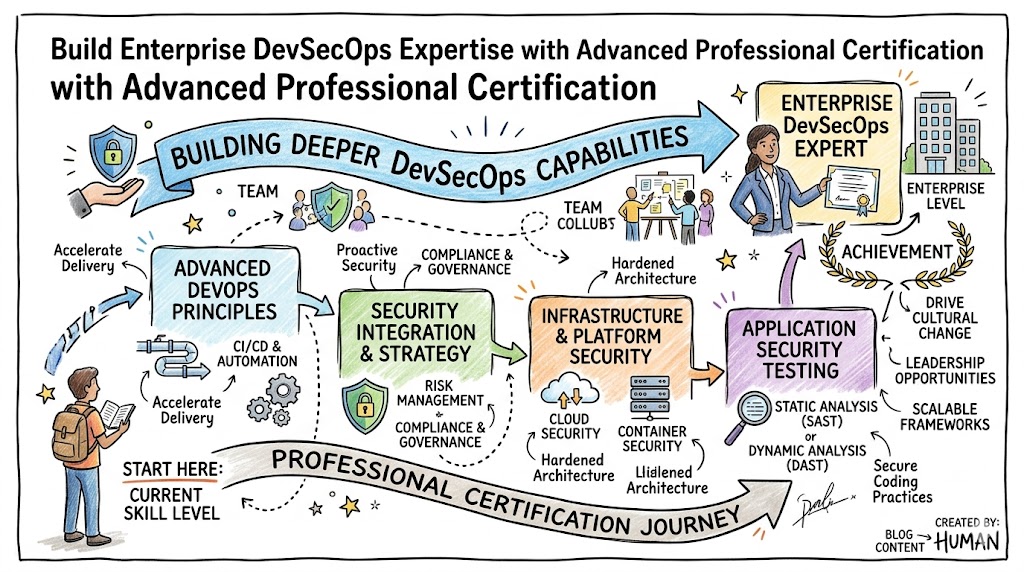
In the current landscape of rapid software delivery, the integration of security into the development and operations lifecycle is no longer optional—it is a critical requirement for enterprise stability. The Certified DevSecOps Professional designation serves as a rigorous benchmark for engineers looking to master the intersection of automation, security, and velocity. Whether you are a seasoned DevOps engineer or an architect transitioning into security-focused roles, this certification provides the structured validation needed to prove your competency in building hardened, compliant delivery pipelines. This guide is designed to help you understand the core tenets of the certification and how to align it with your professional growth goals. By leveraging industry-recognized resources like devopsschool and specialized platforms like aiopsschool, professionals can build a roadmap that bridges the gap between theoretical knowledge and production-ready implementation.
What is the Certified DevSecOps Professional?
The Certified DevSecOps Professional represents a comprehensive approach to securing the software supply chain through automation. It is not merely about learning security tools; it is about embedding security culture into every stage of the CI/CD pipeline, from initial code commit to final deployment and monitoring. This certification emphasizes practical, hands-on ability over rote memorization, ensuring that practitioners understand how to manage vulnerabilities, automate compliance, and implement security-as-code effectively. It exists to bridge the historic divide between security teams and development teams, fostering a unified environment where security is a shared responsibility rather than an afterthought.
Who Should Pursue Certified DevSecOps Professional?
This certification is designed for software engineers, DevOps practitioners, and Site Reliability Engineers who are tasked with securing cloud-native environments. It is equally valuable for security professionals looking to modernize their skill sets by moving from traditional perimeter defense to automated, pipeline-integrated security practices. Managers and technical leads will also find immense value in understanding the methodologies required to govern distributed systems and ensure that engineering teams maintain security standards without sacrificing deployment speed. Given the global demand for secure software engineering practices, this certification is highly relevant for professionals operating within the Indian technology sector and international markets alike.
Why Certified DevSecOps Professional
As organizations shift toward increasingly complex distributed architectures, the ability to automate security becomes a primary driver of operational efficiency and risk mitigation. This certification helps professionals stay relevant by focusing on evergreen concepts—such as identity management, threat modeling, and secure configuration—rather than being tied to the lifecycle of a single tool. It provides a significant return on investment by validating your expertise to potential employers and demonstrating a commitment to professional growth. In a competitive job market, holding a globally recognized standard for secure automation serves as a powerful differentiator that can unlock higher-tier roles and increased earning potential.
Certified DevSecOps Professional Certification Overview
The program is delivered via and hosted on devopsschool. It is structured to provide a deep dive into the technical and procedural aspects of DevSecOps, focusing on real-world scenarios that engineers face in high-stakes production environments. The assessment approach typically involves a combination of theoretical knowledge and practical tasks, requiring candidates to demonstrate their ability to solve complex integration challenges. This certification is owned and developed by industry experts, ensuring that the curriculum remains aligned with modern enterprise practices and evolving security threats.
Certified DevSecOps Professional Certification Tracks & Levels
The certification structure is designed to accommodate various levels of expertise, ranging from fundamental concepts to highly specialized technical implementations. The foundation level focuses on core principles and pipeline security, while professional and advanced levels delve into infrastructure-as-code security, runtime protection, and incident response automation. Specialization tracks allow engineers to focus on specific areas such as cloud security, container orchestration, or policy-as-code. These levels are mapped to standard career progression paths, enabling individuals to build a modular portfolio of skills that support their long-term career objectives.
Complete Certified DevSecOps Professional Certification Table
| Track | Level | Who it’s for | Prerequisites | Skills Covered | Recommended Order |
| Security | Foundation | Beginners | Basic Linux/DevOps knowledge | Pipeline Security Basics | 1 |
| Security | Professional | Experienced Engineers | Foundation Cert | Automated Vulnerability Scanning | 2 |
| Security | Advanced | Architects | Professional Cert | Policy-as-Code & Hardening | 3 |
Detailed Guide for Each Certified DevSecOps Professional Certification
Certified DevSecOps Professional – Professional Level
What it is
This certification validates the candidate’s ability to implement comprehensive security controls across a full-stack CI/CD environment. It focuses on the integration of security tools into existing automated workflows without creating operational bottlenecks.
Who should take it
DevOps engineers, SREs, and security analysts with hands-on experience in cloud environments. It is ideal for those who have moved past basic tool usage and are ready to manage security at scale.
Skills you’ll gain
- Implementing static and dynamic application security testing.
- Managing container image security and supply chain integrity.
- Automating secret management and rotation strategies.
- Integrating compliance checks into deployment pipelines.
Real-world projects you should be able to do
- Build a fully automated hardened CI/CD pipeline from scratch.
- Perform an end-to-end security audit on a microservices deployment.
- Configure automated threat detection and incident response workflows.
- Apply least-privilege access patterns to cloud infrastructure.
Preparation plan
- 14 days: Review fundamental security principles and documentation of primary security toolsets.
- 30 days: Engage in hands-on lab exercises, focusing on pipeline integration and configuration scenarios.
- 60 days: Participate in simulated project environments to solidify understanding and troubleshoot integration errors.
Common mistakes
Candidates often focus too much on learning a specific vendor tool rather than understanding the underlying security logic. Neglecting the “Operations” side of DevSecOps often leads to security implementations that break deployment workflows.
Best next certification after this
- Same-track option: Advanced Certified DevSecOps Architect.
- Cross-track option: Certified SRE Professional.
- Leadership option: Certified DevOps Leader.
Choose Your Learning Path
DevOps Path
The DevOps path focuses on the foundational requirements of automating delivery pipelines and infrastructure provisioning. It serves as the bedrock for all other specializations, emphasizing the removal of manual tasks and the implementation of robust deployment strategies. Mastering this path allows you to understand how secure code transitions through various environments reliably.
DevSecOps Path
This path builds upon basic DevOps skills by introducing specialized security layers into the automation stack. You will learn to perform continuous security testing, manage complex identity and access requirements, and ensure that infrastructure remains compliant as it scales. It is the most critical path for those looking to secure modern, cloud-native enterprise ecosystems.
SRE Path
The SRE path bridges the gap between development and operations by focusing on reliability, scalability, and performance monitoring. You will learn how to define and measure service level objectives while ensuring that security measures do not negatively impact the availability or latency of critical production applications.
AIOps Path
The AIOps path is dedicated to the application of machine learning and data analytics to optimize IT operations. You will explore how to automate anomaly detection, predictive maintenance, and root cause analysis in complex, high-traffic systems. This path is essential for those aiming to move into intelligence-driven operations.
MLOps Path
The MLOps path focuses on the unique challenges of managing the lifecycle of machine learning models in production. You will learn how to automate the training, validation, and deployment of models while maintaining version control and reproducibility. It integrates data science requirements with robust engineering principles.
DataOps Path
The DataOps path focuses on creating efficient, reliable, and secure data pipelines that support analytics and business intelligence. You will learn how to orchestrate complex data workflows, ensure data quality at scale, and automate the ingestion and transformation processes necessary for modern data-driven enterprises.
FinOps Path
The FinOps path centers on cloud financial management, teaching you how to balance cost, speed, and quality. You will learn how to gain visibility into cloud spending, allocate costs accurately, and implement optimization strategies that align with technical requirements. It is a vital path for anyone involved in cloud architecture and budgeting.
Role → Recommended Certified DevSecOps Professional Certifications
| Role | Recommended Certifications |
| DevOps Engineer | Certified DevSecOps Professional |
| SRE | Certified DevSecOps Professional + SRE Professional |
| Platform Engineer | Certified DevSecOps Professional + Infrastructure Automation |
| Cloud Engineer | Certified DevSecOps Professional + Cloud Security |
| Security Engineer | Certified DevSecOps Professional |
| Data Engineer | Certified DevSecOps Professional + DataOps Certification |
| FinOps Practitioner | Certified DevSecOps Professional + FinOps Certification |
| Engineering Manager | Certified DevSecOps Professional (Leadership Track) |
Next Certifications to Take After Certified DevSecOps Professional
Same Track Progression
Once you have mastered the professional level, consider pursuing advanced-level certifications that focus on architecture, policy enforcement at scale, and complex regulatory compliance. Deepening your expertise in specific domains like container orchestration security or cloud-native infrastructure hardening is the logical next step for becoming a subject matter expert.
Cross-Track Expansion
Broadening your skill set by moving into SRE or DataOps tracks allows you to become a well-rounded engineer. Understanding how security principles intersect with site reliability or data pipeline integrity provides a holistic view of the engineering ecosystem, making you more adaptable in dynamic team environments.
Leadership & Management Track
For those looking to transition into team leadership or management, focus on certifications that emphasize governance, strategy, and team-based delivery. These paths help you translate your deep technical knowledge into actionable roadmaps for engineering organizations, focusing on culture, productivity, and risk management.
Training & Certification Support Providers for Certified DevSecOps Professional
DevOpsSchool offers comprehensive training programs that emphasize practical application and project-based learning to prepare engineers for the realities of the modern workforce.
Cotocus provides structured pathways for professional development with a focus on deep technical skill acquisition and mentorship-led educational delivery.
Scmgalaxy focuses on source code management and CI/CD best practices, helping candidates bridge the gap between development workflows and operational requirements.
BestDevOps provides curated content and certification support designed to keep engineering professionals updated on the latest industry standards and technical trends.
devsecopsschool specializes in the intersection of security and development, providing in-depth training on hardening pipelines and protecting cloud-native environments.
sreschool delivers training focused on reliability engineering, helping professionals master the art of maintaining uptime and performance in large-scale systems.
aiopsschool offers expert-led courses on integrating artificial intelligence into operational workflows to drive efficiency and predictive performance.
dataopsschool focuses on the management and security of data pipelines, ensuring that data-driven organizations maintain high standards of quality and reliability.
finopsschool provides education on cloud financial management, helping engineers and managers optimize spending without sacrificing technical innovation.
Frequently Asked Questions (General)
- What is the typical difficulty level of these certifications?
The certifications are designed to be challenging, focusing on practical application rather than theoretical recall, which typically requires hands-on practice. - How much time should I dedicate to preparation?
While it varies by individual, most professionals find that a structured 30 to 60-day plan is sufficient if they have relevant industry experience. - Are there any formal prerequisites for the entry-level exams?
Most levels require a basic understanding of Linux, cloud environments, and CI/CD pipelines to ensure you can follow the practical components. - What is the ROI of obtaining these professional certifications?
These certifications provide clear validation of your skills, often leading to better job opportunities, higher salary brackets, and increased professional credibility. - Can I take these exams completely online?
Yes, most certification providers offer flexible online testing options to accommodate working professionals across different time zones and locations. - How often should I renew my certification?
Certification validity typically spans two to three years, as technology in the DevOps and security space evolves, requiring periodic updates to your knowledge. - How do these certifications help in a career change?
They provide a standardized way to demonstrate your competency to employers, proving that you have met a verified set of technical benchmarks. - Is practical experience necessary before starting?
While you can learn the concepts without it, having some real-world exposure to pipelines or cloud infrastructure will significantly ease the learning curve. - Which track should I start with if I am a complete beginner?
It is recommended to start with the foundational DevOps track to establish a baseline before moving into specialized security or reliability domains. - How do I manage preparation while working full-time?
Focus on a consistent, small-block study schedule and prioritize lab work on weekends to apply what you have learned during the week. - Do these providers offer post-certification support?
Many providers offer access to professional communities, newsletters, and ongoing resources to help you stay updated after you earn your badge. - Are these certifications recognized internationally?
Yes, these certifications are designed based on global industry standards, making them highly respected by international engineering organizations.
FAQs on Certified DevSecOps Professional
- What specific security tools are covered?
The program focuses on industry-standard toolsets for SAST, DAST, SCA, and infrastructure hardening rather than specific proprietary vendor tools. - Does this cover Kubernetes security?
Yes, container and orchestration security are core components of the curriculum, addressing common threats in cloud-native environments. - Is coding experience required?
Basic scripting ability in languages like Python or Shell is highly recommended as it is essential for automating security tasks. - Does this certification cover regulatory compliance?
Yes, it covers the principles of integrating compliance requirements into automated delivery workflows. - How is the practical exam evaluated?
The assessment typically involves completing a series of lab-based tasks that are validated by automated systems or expert review. - Can this help me with a security clearance or audit?
While it is not a legal credential, it demonstrates a high level of professional proficiency in secure practices that auditors often look for. - Is it suitable for cloud-only roles?
Absolutely, the certification is heavily focused on cloud-native security and is highly applicable to any cloud-first architecture. - How does this differ from traditional security certs?
Traditional certifications often focus on policies and perimeter defense, whereas this focuses on automation and integration within software engineering.
Final Thoughts: Is Certified DevSecOps Professional Worth It?
If you are an engineer looking to bridge the gap between delivery speed and security, this certification is a highly practical investment. It forces you to move beyond high-level theory and grapple with the realities of configuring, auditing, and maintaining production systems. As systems become more complex, the ability to automate security will be the defining trait of successful engineering teams. If you approach this with a mindset of continuous improvement and a willingness to apply these concepts in real-world environments, you will find it to be an invaluable asset to your career trajectory. Avoid treating this as a simple badge to add to your resume; treat it as a framework for your ongoing professional development.