
Introduction
Managing cloud expenditures has transformed from a passive accounting chore into an active engineering discipline. The Certified FinOps Engineer path bridges the divide between daily infrastructure management and strategic financial planning, providing technical professionals with the frameworks needed to build cost-aware systems without compromising system velocity or performance. This guide is crafted for software developers, systems operators, platform teams, and solutions architects operating within complex multi-cloud environments. By breaking down core principles, structured certification tiers, and real-world execution models, tech leaders can make data-driven career choices and build highly efficient cloud operations.
What is the Certified FinOps Engineer?
The Certified FinOps Engineer credential defines an operational methodology designed to embed financial accountability directly into software development pipelines. Instead of relying on delayed end-of-month invoice reviews, this framework prioritizes real-time expense visibility, unit economics, automated waste elimination, and cross-departmental alignment.
It resolves the natural operational friction between finance groups, who require predictable forecasts, and product squads, who need rapid resource access. Candidates learn to implement live telemetry monitoring, automate policy controls via code, and manage serverless or auto-scaling architectures efficiently. The focus stays firmly on production-grade engineering outcomes over theoretical concepts, preparing engineers to handle heavy cloud usage cleanly.
Who Should Pursue Certified FinOps Engineer?
- Cloud & Infrastructure Engineers: Specialists looking to expand beyond resource provisioning and gain full control over cost-optimized system design.
- DevOps & Site Reliability Engineers (SREs): Practitioners managing continuous delivery setups who need to integrate real-time cost governance into deployment workflows.
- Platform Engineers & System Architects: Technical designers building internal developer portals that enforce budget limits by default.
- Engineering Managers & FinOps Practitioners: Team leads establishing structured fiscal accountability across engineering teams.
- Data, Security, and Cloud Specialists: Enterprise professionals aiming to master globally recognized practices for controlling cloud operational waste.
Why Certified FinOps Engineer
Enterprise reliance on cloud infrastructure is a permanent reality. However, unmanaged resource consumption quickly degrades profit margins, forcing companies to prioritize financial efficiency alongside system stability and security. Developing expertise as a Certified FinOps Engineer ensures you remain essential in a market where operational efficiency is prized just as highly as technical innovation.
This discipline teaches timeless principles—such as unit metric tracking, resource tagging frameworks, and architectural rightsizing—that remain valuable regardless of how cloud providers or tooling change over time. Dedicating effort to these concepts yields sustainable long-term professional advantages, positioning you at the intersection of enterprise strategy and technical execution.
Certified FinOps Engineer Certification Overview
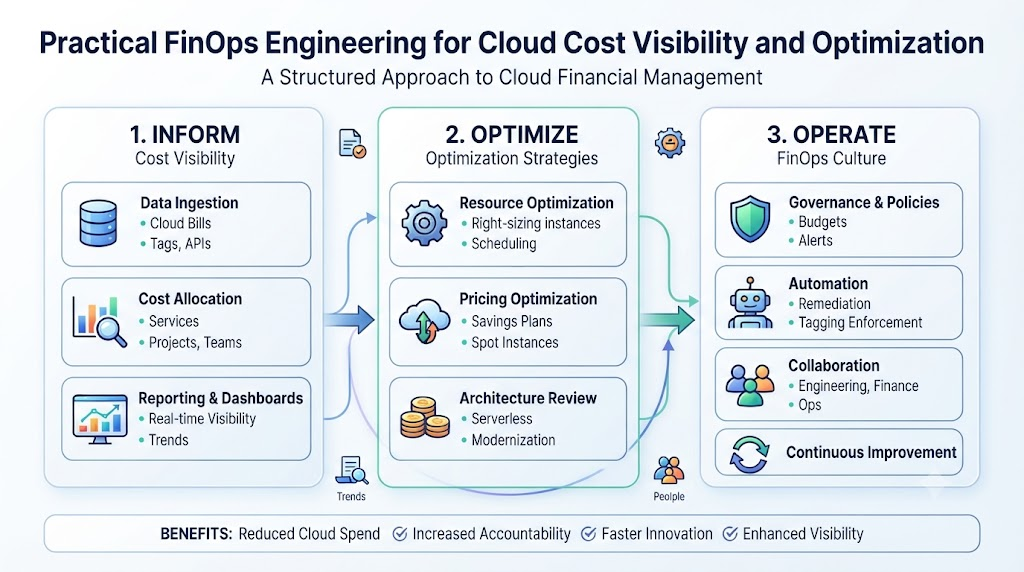
The program structure offers a solid mix of technical concepts and practical execution strategies. It is delivered via the official training portal hosted on FinOpsSchool. The learning modules are organized around the three core phases of cloud financial management: Inform, Optimize, and Operate.
Rather than relying purely on basic multiple-choice testing, the assessment evaluates an engineer’s practical capacity to parse complex usage data, write resource cleanup scripts, optimize commitment portfolios, and build accurate showback models. Earning the credential proves that an engineer can manage large-scale cloud budgets without slowing technical progress.
Certified FinOps Engineer Certification Tracks & Levels
To support professionals at every stage of their career, the framework provides a progressive learning path.
- Foundation Level: Focuses on foundational terminology, cloud billing mechanics, resource tagging standards, and organizational cultural alignment.
- Professional Level: Covers active cost engineering, anomaly detection rules, commitment planning (Savings Plans, Reserved Instances), and container allocation.
- Advanced Level: Tailored for enterprise architects and leaders designing multi-cloud unit economics, chargeback engines, policy-as-code automation, and broad governance frameworks.
Specialized modules also allow engineers to align their learning directly with DevOps, SRE, and Platform Operations disciplines.
Complete Certified FinOps Engineer Certification Table
| Track | Level | Who it is for | Prerequisites | Skills Covered | Recommended Order |
| FinOps Foundations | Associate | Junior Engineers, Analysts, Product Owners | Basic Cloud Familiarity | Billing Fundamentals, Spend Visibility, Tagging Rules | Step 1 |
| FinOps Certified Practitioner | Professional | Cloud Engineers, DevOps, FinOps Analysts | 1+ Years Cloud Experience | Anomaly Detection, Shared Allocation, Waste Reduction | Step 2 |
| Certified FinOps Engineer | Professional | DevOps, SREs, Platform Teams | Hands-on Infrastructure Experience | IaC Cost Governance, Container Tracking, Automation | Step 3 |
| FinOps Architect & Leader | Advanced | Enterprise Architects, Directors, Principal SREs | Multi-Cloud & Leadership Experience | Unit Economics, Chargeback Automation, Enterprise Policy | Step 4 |
Detailed Guide for Each Certified FinOps Engineer Certification
Certified FinOps Engineer – Associate Level
What it is
Validates core understanding of cloud spending patterns, invoice navigation, visibility tools, and the primary operational stages of cloud financial management.
Who should take it
Ideal for early-career cloud specialists, junior analysts, system administrators, and project managers looking for a grounded entry into cloud financial concepts.
Skills you will gain
- Reading public cloud invoices and breakdown reports
- Implementing consistent tagging and metadata governance strategies
- Identifying idle, unattached, or underutilized cloud resources
- Using built-in cloud management dashboards across major platforms
Real-world projects you should be able to do
- Create a central cost tracking dashboard for a single cloud account.
- Deploy a standardized tagging policy across core infrastructure components.
- Generate regular resource optimization reports for technical leads.
Preparation plan
- 7–14 Days: Review basic cloud billing guides and foundational terminology.
- 30 Days: Practice analyzing sample billing data and setting up custom alert thresholds.
- 60 Days: Study multi-cloud pricing structures and run basic resource audits on test environments.
Common mistakes
Focusing only on theoretical definitions without understanding how different pricing models impact live workloads.
Best next certification after this
- Same-track option: Certified FinOps Engineer – Professional Level
- Cross-track option: Certified DevOps Engineer
- Leadership option: Certified Cloud Delivery Manager
Certified FinOps Engineer – Professional Level
What it is
Verifies technical ability in automating spend control pipelines, managing commitment discount plans, enforcing policy via code, and allocating shared cluster expenses.
Who should take it
Designed for active DevOps practitioners, SREs, systems engineers, and cloud architects running production environments.
Skills you will gain
- Writing automated cleanup tasks using serverless functions
- Managing commitment coverage across Reserved Instances and Savings Plans
- Allocating Kubernetes and container cluster costs to specific teams
- Adding static cost analysis directly into continuous deployment pipelines
Real-world projects you should be able to do
- Set up automated spend anomaly detection with direct alert integration.
- Add an infrastructure-as-code linting step that blocks high-cost resource provisioning.
- Build a clear cost allocation system for multi-tenant Kubernetes environments.
Preparation plan
- 7–14 Days: Study advanced allocation methods and commitment discount models in detail.
- 30 Days: Write and test automation scripts for scheduled shutdowns and orphaned resource removal.
- 60 Days: Perform architectural evaluations assessing compute choices, storage tiers, and network egress costs.
Common mistakes
Relying on manual cleanup efforts instead of building repeatable, policy-driven code automations.
Best next certification after this
- Same-track option: Certified FinOps Engineer – Advanced Level
- Cross-track option: Certified Site Reliability Engineer (SRE)
- Leadership option: Certified Infrastructure Director
Certified FinOps Engineer – Advanced Level
What it is
Confirms expert-level skill in enterprise unit metrics, complex multi-cloud financial architectures, custom policy engines, and organizational transformation.
Who should take it
Built for principal engineers, enterprise architects, infrastructure leaders, and senior FinOps directors guiding large cloud footprints.
Skills you will gain
- Defining advanced unit cost metrics tied to core business activities
- Building automated chargeback systems connected to corporate accounting tools
- Architecting multi-cloud governance frameworks and automated compliance guards
- Leading organizational shifts that align technical speed with financial discipline
Real-world projects you should be able to do
- Design an end-to-end multi-cloud reporting platform with fully automated chargeback logic.
- Develop an enterprise unit-cost model measuring expenses per active user transaction.
- Establish organization-wide governance standards across distributed engineering groups.
Preparation plan
- 7–14 Days: Review enterprise chargeback structures, tax handling, and global financial standards.
- 30 Days: Evaluate complex multi-cloud architecture scenarios and draft cost-aware blueprints.
- 60 Days: Create comprehensive strategic roadmaps that pair technical operations with corporate accounting goals.
Common mistakes
Focusing exclusively on technical tooling while ignoring the organizational alignment and cultural changes required for adoption.
Best next certification after this
- Same-track option: Executive Enterprise Architect Specialist
- Cross-track option: Advanced Platform Operations Leader
- Leadership option: VP of Cloud Engineering Track
Choose Your Learning Path
DevOps Path
The DevOps learning route weaves cost management directly into delivery pipelines and infrastructure code. Engineers learn to embed budget validation alongside automated unit and security tests. By treating expense as a primary operational metric equal to performance, deployment checks prevent accidental cost spikes before changes hit production.
DevSecOps Path
This track pairs resource optimization with security compliance and risk prevention. Security audits frequently uncover unmonitored or abandoned resources, which represent both security vulnerabilities and wasted expenditure. Candidates master methods to streamline security platforms, clean up abandoned assets automatically, and maintain audit-compliant setups economically.
SRE Path
Site Reliability Engineers focus on balancing uptime guarantees, response speeds, and operational costs. This pathway covers how to incorporate spend metrics into service level objectives (SLOs) and error budget calculations. SREs learn to build resilient, auto-scaling setups that preserve high availability while scaling down during off-peak hours.
AIOps Path
The AIOps specialization centers on using machine learning techniques and algorithmic models to analyze complex operational and cost telemetry. Engineers learn to construct setups that detect spending anomalies automatically, forecast upcoming resource demands, and balance system capacity in real time without human intervention.
MLOps Path
Focuses on managing the heavy computing costs tied to training, tuning, and hosting machine learning models. This track covers GPU scheduling, distributed training cluster efficiency, feature store storage controls, and model endpoint scaling. Specialists gain the expertise needed to deliver AI capabilities while staying within strict project budgets.
DataOps Path
Large-scale data pipelines, analytical warehouses, and distributed query engines can generate massive cloud costs if left unmonitored. This pathway concentrates on query optimization, storage lifecycle policies, dynamic processing cluster scaling, and cost-effective data architecture. Data engineers learn to deliver fast insights while maintaining tight spend controls.
FinOps Path
The dedicated FinOps path delivers a comprehensive focus on financial management, unit metrics, chargeback engine design, and cross-team collaboration. Practitioners build the communication and technical skills needed to unite engineering squads, finance teams, and executive management around cloud business value.
Role → Recommended Certifications
| Role | Recommended Certifications |
| DevOps Engineer | Certified FinOps Engineer (Professional), Certified DevOps Practitioner |
| SRE | Certified FinOps Engineer (Professional), Certified SRE Professional |
| Platform Engineer | Certified FinOps Engineer (Advanced), Certified Platform Architect |
| Cloud Engineer | Certified FinOps Associate, Certified FinOps Engineer (Professional) |
| Security Engineer | Certified DevSecOps Specialist, Certified FinOps Associate |
| Data Engineer | Certified DataOps Engineer, Certified FinOps Engineer (Professional) |
| FinOps Practitioner | Certified FinOps Practitioner, Certified FinOps Engineer (Advanced) |
| Engineering Manager | Certified FinOps Lead, Executive Cloud Governance Specialist |
Next Certifications to Take After Certified FinOps Engineer
Same Track Progression
After mastering technical cost controls, the logical next milestone is stepping up to the Lead FinOps Architect level. This advanced specialization deepens knowledge in enterprise-wide billing structures, custom unit-metric modeling, and automated governance systems across complex environments. It prepares senior engineers to build organization-wide controls that enforce fiscal discipline across dozens of product teams automatically.
Cross-Track Expansion
Expanding your skills into Site Reliability Engineering (SRE) or Platform Engineering complements financial optimization experience effectively. Learning to build modern, self-service internal developer platforms (IDPs) allows you to build cost controls directly into developer tools. Combining FinOps expertise with SRE methodologies equips you to balance system availability, response speeds, and cloud expenditures.
Leadership & Management Track
For engineers aiming for engineering manager, director, or executive positions, moving into Cloud Technology Governance and Technology Financial Leadership is a strong step. This progression emphasizes vendor negotiations, team structure alignment, organizational change management, and executive reporting. It transforms technical optimization wins into business outcomes that resonate with leadership teams.
Training & Certification Support Providers for Certified FinOps Engineer
The Core Platform Authority
FinOpsSchool operates as the primary platform authority for the Certified FinOps Engineer curriculum. It defines standard learning paths, hands-on lab environments, and assessment criteria for these qualifications. The platform updates its modules regularly to reflect changes in multi-cloud pricing structures, container cost allocation practices, and new automated governance tooling. By holding strict, practical standards, FinOpsSchool ensures certified engineers acquire actionable skills ready for production environments.
DevOpsSchool
DevOpsSchool is a prominent global training institution specializing in immersive technical education, expert-led workshops, and career development bootcamps for software professionals. Their curriculum bridges theoretical knowledge and practical execution across DevOps pipelines, cloud infrastructure management, automation, and cost engineering.
The organization provides comprehensive study kits, real-world scenario guides, hands-on lab access, and continuous post-training support. Their programs are designed to help engineers, operations teams, and IT leaders build job-ready skills that can be implemented directly into enterprise workflows.
Cotocus
Cotocus offers specialized IT consulting services, corporate transformation programs, and technical training solutions. Their work centers on helping businesses modernize infrastructure, adopt automated cost controls, and build strong platform engineering foundations across technical teams.
Scmgalaxy
Scmgalaxy is a popular community portal and resource hub offering detailed tutorials, configuration management guides, and learning tools for infrastructure engineers and automation enthusiasts.
BestDevOps
BestDevOps delivers curated educational materials, tool reviews, industry insights, and structured learning roadmaps built for modern cloud engineers and system operations teams.
devsecopsschool.com
devsecopsschool.com focuses on technical training at the intersection of security automation, cloud compliance, and pipeline management. It teaches teams how to build security directly into deployment workflows without causing operational friction.
sreschool.com
sreschool.com provides targeted educational tracks covering system reliability, telemetry design, incident management, and chaos engineering, helping professionals build high-availability architectures cost-effectively.
aiopsschool.com
aiopsschool.com delivers specialized instruction on applying artificial intelligence and machine learning to modern IT operations, focusing on automated anomaly detection and intelligent system monitoring.
dataopsschool.com
dataopsschool.com focuses on the learning requirements of data engineering teams, providing clear tracks on optimizing data processing pipelines, managing analytical stores, and reducing cloud storage expenses.
finopsschool.com
finopsschool.com acts as an educational platform dedicated to cloud cost governance, chargeback strategies, unit economic models, and cross-functional team alignment.
Frequently Asked Questions (General)
- How difficult is the Certified FinOps Engineer assessment?
The exam evaluates both cloud technical mechanics and financial management concepts, making it moderately challenging for those without practical exposure. Real experience with cloud billing dashboards, resource tag policies, and scripting makes preparation significantly smoother. - How much preparation time is typically needed?
Most working professionals spend about 30 to 60 days preparing, studying roughly 5 to 7 hours per week. Candidates with hands-on experience in public cloud management can often complete their study in 3 weeks. - Are there rigid prerequisites to join the program?
There are no strict prerequisites for the entry tier, though basic cloud awareness is helpful. Higher tiers expect hands-on experience with cloud infrastructure, command-line interfaces, and basic scripting. - What is the expected career ROI for earning this credential?
This certification proves your ability to reduce unneeded cloud spend and optimize infrastructure investments. Companies actively seek professionals who can balance speed with cost control, making this skill a strong asset for career growth. - How does this differ from vendor-specific cloud certifications?
Vendor certifications focus primarily on the specific services of a single cloud provider. This framework emphasizes cross-platform financial strategy, unit metric frameworks, and cost management practices that apply universally across AWS, Azure, and Google Cloud. - Is this track useful for non-technical finance professionals?
Yes, finance professionals can start with the entry-level track to build a firm grasp of cloud concepts. However, advanced technical modules require working familiarity with cloud services and developer workflows. - How often is the course content updated?
The curriculum and practical labs are updated regularly to stay aligned with cloud vendor pricing changes, container tracking models, and modern policy automation tools. - What order should I follow when taking these courses?
We recommend starting with the Foundations tier to build core vocabulary, moving to the Professional tier for hands-on technical skills, and finishing with the Advanced level for enterprise strategy and unit economics. - Does the curriculum cover cost allocation for Kubernetes?
Yes, allocating costs across multi-tenant Kubernetes clusters, shared storage, and dynamic workloads forms a key part of the professional and advanced tracks. - Are the concepts applicable to multi-cloud setups?
Yes, the underlying frameworks—such as tagging conventions, anomaly rules, commitment management, and unit cost formulas—apply across AWS, Microsoft Azure, Google Cloud, and hybrid deployments. - How does this credential influence long-term career progression?
It places you at the intersection of technical engineering and financial management. Engineers who can design cost-efficient architectures are well-positioned for senior technical leadership and management roles. - Is automated policy enforcement included in the modules?
Yes, advanced tracks focus on using infrastructure-as-code checks, automated serverless routines, and policy engines to prevent costly misconfigurations from reaching production.
FAQs on Certified FinOps Engineer
- Which public cloud platforms are featured in the coursework?
The material covers AWS, Microsoft Azure, and Google Cloud Platform, highlighting native billing tools, allocation options, and API integrations across all three major providers. - How does the curriculum address serverless architecture expenses?
The modules cover pricing for event-driven compute, API gateways, and cloud databases, teaching you how to evaluate call volumes and memory settings to optimize serverless application costs. - Will I learn to build automated cost-reporting routines?
Yes, practical exercises guide you through pulling billing data via APIs, parsing usage files, and pushing automated alerts to messaging platforms or dashboards. - What tools are used for practicing spend governance?
The coursework covers cloud-native billing tools alongside open-source platforms like Infracost, Kubecost, and policy engines like Open Policy Agent (OPA). - How does the course teach commitment discount management?
You will analyze strategies for combining Savings Plans, Reserved Instances, and Spot compute, learning how to maximize discounts while maintaining operational capacity. - Is software license management included in the learning modules?
Yes, the curriculum covers enterprise licensing strategies, Bring-Your-Own-License (BYOL) frameworks, and methods to avoid unnecessary OS and database licensing expenses. - How are shared infrastructure costs managed in the training?
You will study different allocation frameworks, including proportional splitting, fixed distributions, and managing central overhead across multi-tenant setups. - What assessment format is used for certification?
The final evaluation blends scenario analysis questions with practical tasks, testing your ability to analyze usage datasets, identify waste, and construct governance policies.
Final Thoughts: Is Certified FinOps Engineer Worth It?
Investing time into mastering cloud financial management is a practical, high-value move for modern tech professionals. As cloud expenses represent a significant portion of IT budgets, organizations increasingly value engineers who can build robust platforms while keeping costs under control.
This path provides a practical skill set spanning software engineering, system architecture, and business operations. Whether you work as an infrastructure engineer, a DevOps specialist, or a technical leader, treating cost as an essential engineering metric makes you a more effective and impactful professional.