
Introduction
The rapid evolution of modern IT infrastructure has shifted the focus from manual monitoring to automated, intelligent operations. As systems grow in complexity across multi-cloud and hybrid environments, the ability to apply artificial intelligence to IT operations has become a critical skill for senior engineers. This Certified AIOps Engineer program, hosted on aiopsschool, is designed to bridge the gap between traditional operations and future-ready automation. Whether you are an SRE, a DevOps practitioner, or a platform engineer, this guide helps you navigate the professional certification landscape to make informed career decisions.
What is the Certified AIOps Engineer?
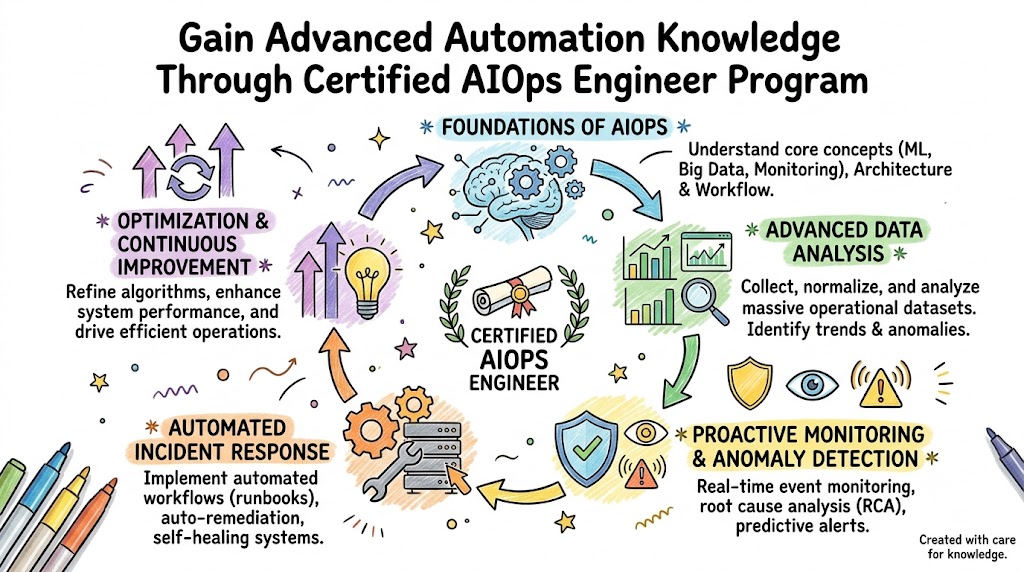
The Certified AIOps Engineer designation represents a specialized standard for professionals who manage, design, and implement intelligent operations within enterprise ecosystems. It is not merely a theoretical examination; it focuses on the practical application of machine learning, data observability, and automated incident response within production-grade environments. By emphasizing real-world problem solving, the certification ensures that engineers can move beyond basic monitoring to proactive system health management. It aligns deeply with the needs of modern organizations that require resilient, self-healing, and data-driven infrastructure workflows.
Who Should Pursue Certified AIOps Engineer?
This certification is designed for professionals who are already working in technical roles and wish to transition into advanced automation and intelligence-driven workflows. It is highly relevant for DevOps engineers, Site Reliability Engineers (SRE), and platform engineers who want to reduce alert fatigue and improve system uptime. Additionally, data engineers and security professionals will find immense value in learning how to leverage operational data to drive decision-making. Whether you are an early-career professional looking to specialize or a seasoned technical leader aiming to modernize your team’s approach, the certification provides a structured path for professional growth in both global and local Indian tech markets.
Why Certified AIOps Engineer
In a landscape where infrastructure complexity is exponentially increasing, the ability to harness data for operational efficiency is a high-demand skill. Enterprises are increasingly adopting AI-driven strategies to stay competitive, making those who can manage these systems essential assets. This certification provides a sustainable framework for your career, ensuring your skills remain relevant even as specific toolsets evolve. It provides a significant return on your time and energy investment by formalizing your expertise, which in turn leads to better career mobility and higher industry recognition in modern engineering roles.
Certified AIOps Engineer Certification Overview
The program is structured to deliver comprehensive knowledge through a practical, assessment-based approach. Hosted on aiopsschool, the certification process is designed to mimic real-world engineering challenges, requiring candidates to demonstrate both conceptual knowledge and hands-on capability. Certification levels are tiered to accommodate various stages of professional expertise, ranging from fundamental principles to advanced architectural design. By standardizing the assessment of these skills, the program provides clear benchmarks for professionals to track their development and prove their competency to current and prospective employers.
Certified AIOps Engineer Certification Tracks & Levels
The certification framework is segmented into levels to ensure that every engineer finds a starting point appropriate for their current skill set. The foundation level focuses on core concepts, terminology, and basic implementation strategies, while the professional level dives into advanced automation, model integration, and architectural decisions. Advanced levels are reserved for those who are building enterprise-wide solutions and require deep expertise in complex, large-scale systems. Specialization tracks allow candidates to align their certification with their specific domain interests, such as SRE-focused intelligence, DevSecOps integration, or FinOps-related operational efficiency.
Complete Certified AIOps Engineer Certification Table
| Track | Level | Who it’s for | Prerequisites | Skills Covered | Recommended Order |
|---|---|---|---|---|---|
| Core Operations | Foundation | Junior DevOps/SRE | Basic Linux/Monitoring | Data Collection, Alerting | 1 |
| Advanced Engineering | Professional | Senior SRE/DevOps | Foundation Certification | Machine Learning, Automation | 2 |
| Architectural Design | Advanced | Principal Engineer | Professional Certification | Model Training, System Design | 3 |
| Domain Specialization | Expert | Tech Lead/Architect | Advanced Certification | Strategy, Governance, ROI | 4 |
Detailed Guide for Each Certified AIOps Engineer Certification
Certified AIOps Engineer – Foundation Level
What it is This certification validates the fundamental understanding of AIOps principles and the ability to integrate basic data collection mechanisms within an existing CI/CD pipeline.
Who should take it It is ideal for junior to mid-level DevOps or platform engineers who have basic exposure to monitoring tools and wish to understand the intelligence layer of modern operations.
Skills you’ll gain
- Understanding data telemetry and logging standards
- Basics of anomaly detection techniques
- Integrating observability tools with automation workflows
- Establishing baseline performance metrics
Real-world projects you should be able to do
- Configure automated data ingestion from multiple log sources
- Set up threshold-based alerting systems with noise reduction
- Document operational data flows for small-scale applications
Preparation plan
- 7–14 days: Focus on core theory and common industry terminology.
- 30 days: Build a small prototype that collects and visualizes operational logs.
- 60 days: Review case studies and perform mock assessments.
Common mistakes
- Focusing solely on tool-specific syntax rather than underlying engineering concepts.
- Neglecting the importance of data quality in operational pipelines.
Best next certification after this
- Same-track: Certified AIOps Engineer – Professional Level
- Cross-track: Certified SRE Practitioner
- Leadership: Certified Engineering Manager
Choose Your Learning Path
DevOps Path
The DevOps path focuses on automating the software delivery lifecycle using intelligent insights. You will learn to use AIOps to accelerate deployment cycles while maintaining high system stability. This path is essential for those who want to integrate intelligence directly into the CI/CD pipeline.
DevSecOps Path
This path emphasizes the intersection of security and intelligent operations. You will learn how to detect security anomalies in real-time, automate incident response for vulnerabilities, and ensure that operational data is used to harden infrastructure against potential threats.
SRE Path
The SRE path is centered on reliability, availability, and performance. You will utilize intelligent monitoring to manage service level objectives (SLOs) and error budgets effectively, ensuring that operational toil is minimized through automated remediation and intelligent alerting.
AIOps / MLOps Path
This path provides a deep dive into the engineering of AI models for operations. It covers model selection, training with operational data, and integrating machine learning workflows into the daily tasks of an operations team.
DataOps Path
The DataOps path focuses on the flow and quality of operational data. You will learn to build robust data pipelines that serve as the foundation for intelligent operations, ensuring that the data used for decision-making is reliable, timely, and accessible.
FinOps Path
The FinOps path centers on using operational intelligence to optimize costs. You will learn to analyze resource usage patterns, identify inefficiencies, and use intelligent insights to align cloud spending with business requirements.
Role → Recommended Certified AIOps Engineer Certifications
| Role | Recommended Certifications |
|---|---|
| DevOps Engineer | Foundation, Professional |
| SRE | Professional, Advanced |
| Platform Engineer | Professional, Advanced |
| Cloud Engineer | Foundation, Professional |
| Security Engineer | Professional, Expert |
| Data Engineer | Foundation, Professional |
| FinOps Practitioner | Professional, Expert |
| Engineering Manager | Professional, Expert |
Next Certifications to Take After Certified AIOps Engineer
Same Track Progression
Once you have mastered the professional level, the logical next step is the advanced architectural certification. This focuses on designing entire operational ecosystems rather than managing individual components, preparing you for senior-level roles.
Cross-Track Expansion
Consider branching into SRE or FinOps certifications to complement your AIOps skills. Combining AIOps with SRE creates a powerful skill set for maintaining high availability, while adding FinOps knowledge ensures your operational work remains cost-effective.
Leadership & Management Track
If you are aiming for management, transition toward certifications focused on engineering leadership, strategic planning, and team management. These programs help you apply your technical knowledge to organizational goals and team development.
Training & Certification Support Providers for Certified AIOps Engineer
DevOpsSchool is a prominent provider offering structured learning paths and hands-on labs designed for modern infrastructure engineers.
Cotocus focuses on professional training and certification programs tailored to enterprise needs, emphasizing practical application over theory.
Scmgalaxy provides resources and training programs specifically for those looking to advance their expertise in configuration management and operations.
BestDevOps offers a range of certification support options for engineers aiming to master the latest in DevOps and automation technologies.
devsecopsschool specializes in the convergence of security and development, providing deep dives into securing automated pipelines.
sreschool focuses on the principles of site reliability engineering, providing comprehensive training for those managing high-scale systems.
aiopsschool is the primary source for this certification, providing the official curriculum and assessment framework for intelligent operations.
dataopsschool offers specialized training on managing operational data, essential for those building intelligence into their infrastructure.
finopsschool provides guidance on managing cloud costs and financial accountability through operational and engineering best practices.
Frequently Asked Questions (General)
- What is the primary difficulty level of this certification? The difficulty is designed to be moderate to high, reflecting the reality of complex enterprise environments and requiring practical problem-solving skills.
- How much time is typically required for preparation? Preparation usually ranges from 30 to 90 days depending on your prior experience with operational systems and machine learning fundamentals.
- Are there any mandatory prerequisites before I start? While not always strictly enforced, having foundational knowledge of Linux, monitoring tools, and CI/CD pipelines is highly recommended for success.
- Does this certification offer a high return on investment? Yes, as it distinguishes professionals in a competitive market by validating specialized skills that are in high demand across the tech industry.
- Is the certification recognized globally? The certification is designed with global industry standards in mind, making it highly relevant for professionals working in diverse geographical locations.
- Can I take the assessment online? Most assessments for these tracks are delivered online, providing flexibility for working professionals to test at their own convenience.
- How often should I renew my certification? Certification standards evolve with technology, so periodic re-certification or supplemental training is recommended every two years to stay current.
- Are there hands-on labs included in the training? Yes, high-quality programs prioritize hands-on labs to ensure you can apply concepts directly to production-like scenarios.
- What is the best way to sequence these certifications? Start with the foundation level, then progress through professional and advanced levels based on your specific role and interest area.
- Will this certification help me get a promotion? By demonstrating specialized expertise and a commitment to modernizing operations, this certification is a strong asset during career growth discussions.
- How do I maintain my status after certification? Maintaining active status typically involves ongoing professional development and participating in community-led initiatives or advanced workshops.
- Is it suitable for beginners in the tech industry? It is better suited for those with some operational experience, but motivated beginners can succeed with dedicated study and practical experimentation.
FAQs on Certified AIOps Engineer
- What specific AI techniques are covered in the curriculum? The curriculum focuses on anomaly detection, predictive analytics, and automated root cause analysis within operational data streams.
- How does this certification differ from standard cloud certifications? Unlike cloud-provider-specific exams, this certification focuses on the overarching intelligence and operational processes applicable across any cloud.
- Are there specific tool-related requirements for the exam? The exam evaluates conceptual and procedural mastery that can be applied across various popular monitoring and observability tools.
- How do I use this certification to improve system reliability? You will learn to implement predictive alerts and automated recovery actions that reduce system downtime and improve service performance.
- Can I use this for non-cloud environments? Yes, the core principles of intelligent operations are applicable to hybrid, on-premises, and multi-cloud environments alike.
- Does the program cover machine learning model maintenance? The advanced tracks include detailed modules on monitoring, retraining, and managing models in a production operational environment.
- What is the passing criteria for the certification? Candidates must demonstrate both theoretical understanding and the ability to solve practical, scenario-based problems during the assessment.
- Is this certification strictly for large-scale enterprise roles? While highly beneficial for large enterprises, the principles are equally valuable for any organization aiming to optimize their IT operations.
Final Thoughts: Is Certified AIOps Engineer Worth It?
In my experience, I have seen many professionals focus too heavily on tools while ignoring the underlying architecture of intelligent operations. This certification serves as a reality check for that trend. It is worth it if you are committed to the long-term goal of building resilient, self-healing systems. If you are just looking for a badge to pad your resume, look elsewhere. However, if you want to master the art of applying intelligence to complex IT problems and advance your career in a high-impact field, this program provides the structured roadmap you need. Be prepared to put in the work, experiment with the concepts, and apply these lessons to real, messy production environments. That is where the real value lies.