
Introduction
Most software delivery pipelines resemble a high-speed assembly line where security only appears as a final, manual inspection at the very end of the process. However, this outdated model creates massive bottlenecks and leaves production systems highly vulnerable to sophisticated, automated attacks. Consequently, the modern industry is moving toward a model where every engineer acts as a critical, first line of defense within the development lifecycle. Accordingly, the DevSecOps Certified Professional (DSOCP) provides the technical framework you need to automate these vital safeguards effectively. Specifically, this guide explains how you can integrate security into your daily workflow without sacrificing deployment speed or developer experience. Moreover, this resource helps you navigate the complex world of cloud-native security with a clear, actionable, and experience-driven roadmap. Therefore, you can make smarter career decisions and secure your place in the future of high-scale platform engineering.
What is the DevSecOps Certified Professional (DSOCP)?
The DevSecOps Certified Professional (DSOCP) represents a hands-on validation of an engineer’s ability to automate security across the CI/CD pipeline. Notably, it exists because traditional manual security audits no longer keep pace with the speed of modern deployment cycles. Therefore, this program focuses on real-world, production-focused learning rather than just theoretical concepts. It aligns perfectly with modern engineering workflows by teaching professionals how to treat security as code. Effectively, it bridges the gap between security teams and development squads, fostering a culture of shared responsibility and enterprise-grade resilience.
Who Should Pursue DevSecOps Certified Professional (DSOCP)?
Software engineers and SREs who want to broaden their technical stack will find this path exceptionally beneficial. Additionally, cloud professionals and security analysts who need to automate their compliance checks should pursue this certification. It caters to beginners who seek a structured entry into the field, as well as experienced leads who must oversee secure platform migrations. Managers also benefit from understanding the architectural implications of DevSecOps. Given the rising focus on data privacy and sovereign clouds, this certification holds immense relevance for professionals in India and across the global tech landscape.
Why DevSecOps Certified Professional (DSOCP) is Valuable and Beyond
The demand for automated security expertise continues to grow as enterprises migrate their critical infrastructure to the cloud. Specifically, organizations now prioritize “shifting left,” which makes DevSecOps skills a long-term necessity for any tech career. This certification helps professionals stay relevant despite frequent changes in the tool ecosystem because it focuses on core principles and logic. Furthermore, the return on time investment is significant, as it positions engineers for high-demand roles in finance, healthcare, and government sectors. Ultimately, mastering these practices ensures career longevity in an increasingly complex threat environment.
DevSecOps Certified Professional (DSOCP) Certification Overview
The program is delivered via the official DSOCP Course URL and is hosted on the DevOpsSchool platform. Notably, the assessment approach emphasizes practical labs and real-world scenarios rather than simple multiple-choice questions. The ownership of the curriculum rests with industry veterans who ensure the content stays aligned with current enterprise practices. Professionally, the structure covers everything from pre-commit hooks to production monitoring. Consequently, candidates gain a holistic understanding of how security layers integrate into a fluid, automated delivery mechanism.
DevSecOps Certified Professional (DSOCP) Certification Tracks & Levels
The certification structure typically includes foundation, professional, and advanced levels to suit various career stages. Specifically, the foundation level introduces core concepts like SCA and SAST, while the professional level dives into DAST and container security. Advanced levels focus on governance at scale and policy-as-code using tools like OPA. These specialization tracks allow DevOps, SRE, and FinOps professionals to tailor their learning journey. Accordingly, as an engineer progresses through these levels, they align their technical growth with more complex leadership and architectural responsibilities.
Complete DevSecOps Certified Professional (DSOCP) Certification Table
| Track | Level | Who it’s for | Prerequisites | Skills Covered | Recommended Order |
| Core Security | Foundation | Beginners & Devs | Basic Linux & Git | SCA, SAST, Secrets Management | 1st |
| Integration | Professional | DevOps Engineers | CI/CD Experience | DAST, Container Scanning, IAST | 2nd |
| Infrastructure | Specialist | Cloud & SREs | Terraform / K8s | Infrastructure as Code Security | 3rd |
| Governance | Advanced | Leads & Architects | Deep DevOps Exp | Policy as Code, Compliance, OPA | 4th |
| Operations | Expert | SRE & SecOps | Incident Resp knowledge | Runtime Security, Falco, IDS | 5th |
Detailed Guide for Each DevSecOps Certified Professional (DSOCP) Certification
DevSecOps Certified Professional (DSOCP) – Foundation Level
What it is This certification validates a candidate’s understanding of the basic “shift-left” philosophy and the primary tools used for scanning source code. It serves as the baseline for all subsequent security automation tasks.
Who should take it Junior developers, fresh graduates, and traditional QA engineers should take this to understand how security integrates into the daily coding routine.
Skills you’ll gain
- Mastery of Software Composition Analysis (SCA) to find vulnerable dependencies.
- Implementation of Static Application Security Testing (SAST) in local environments.
- Basic understanding of Git hooks for secret detection.
- Understanding the DevSecOps maturity model.
Real-world projects you should be able to do
- Configure a pre-commit hook that prevents developers from pushing API keys to GitHub.
- Setup a SonarQube instance to analyze a Java or Python project for code smells and vulnerabilities.
Preparation plan
- 7 Days: Focus on the theory of DevSecOps and basic security terminology.
- 30 Days: Practice setting up local SCA and SAST tools on sample repositories.
- 60 Days: Deep dive into integrating these tools within a basic Jenkins or GitHub Actions pipeline.
Common mistakes
- Ignoring the cultural aspect of DevSecOps and focusing only on the tools.
- Failing to understand the difference between a false positive and a real vulnerability.
Best next certification after this
- Same-track option: DSOCP Professional Level.
- Cross-track option: Certified Kubernetes Administrator (CKA).
- Leadership option: DevOps Leader (DOL).
DevSecOps Certified Professional (DSOCP) – Professional Level
What it is This level confirms your ability to build and maintain fully automated security gates within a complex CI/CD pipeline. It focuses heavily on dynamic testing and containerized workloads.
Who should take it DevOps Engineers and Security Professionals with at least two years of experience should pursue this to solidify their automation expertise.
Skills you’ll gain
- Implementation of Dynamic Application Security Testing (DAST) in staging environments.
- Advanced container image scanning using tools like Trivy or Aqua.
- Integration of security results into centralized dashboards.
- Configuration of automated “break-the-build” logic based on severity scores.
Real-world projects you should be able to do
- Create a Jenkins pipeline that automatically scans Docker images for CVEs before pushing to a registry.
- Deploy an OWASP ZAP proxy to perform automated penetration tests against a running web application.
Preparation plan
- 7 Days: Review container security best practices and Dockerfile hardening.
- 30 Days: Build multi-stage pipelines that include security gates.
- 60 Days: Practice troubleshooting integration issues between CI tools and security scanners.
Common mistakes
- Setting security thresholds too high, which causes constant pipeline failures and developer frustration.
- Neglecting the security of the CI/CD platform itself (e.g., Jenkins or GitLab).
Best next certification after this
- Same-track option: DSOCP Advanced/Expert Level.
- Cross-track option: AWS Certified Security – Specialty.
- Leadership option: Certified Information Systems Security Professional (CISSP).
DevSecOps Certified Professional (DSOCP) – Advanced Infrastructure Security
What it is This certification proves you can secure the actual platform where applications reside, focusing on Infrastructure as Code (IaC) and cloud configurations.
Who should take it Cloud Architects and Platform Engineers who manage AWS, Azure, or GCP infrastructure at scale should take this.
Skills you’ll gain
- Auditing Terraform and CloudFormation templates for misconfigurations.
- Implementing Policy as Code using Open Policy Agent (OPA).
- Securing Kubernetes clusters using Network Policies and RBAC.
- Automating compliance checks against CIS benchmarks.
Real-world projects you should be able to do
- Use Checkov or Terrascan to automatically block the creation of public S3 buckets in a Terraform plan.
- Implement a Kubernetes Admission Controller that prevents containers from running as the root user.
Preparation plan
- 7 Days: Learn the syntax and logic of Rego (for OPA).
- 30 Days: Apply IaC scanning to various cloud provider templates.
- 60 Days: Build a comprehensive governance framework that audits multi-account cloud environments.
Common mistakes
- Relying solely on cloud-native tools without understanding the underlying security principles.
- Hardcoding security policies rather than using a version-controlled “Policy as Code” approach.
Best next certification after this
- Same-track option: DevSecOps Expert (Runtime & Incident Response).
- Cross-track option: Certified FinOps Practitioner.
- Leadership option: Chief Information Security Officer (CISO) training paths.
Choose Your Learning Path
DevOps Path
Engineers following the DevOps path should focus on integrating security scanners directly into their CI/CD tools. Specifically, they need to master the art of “security gates” that do not hinder the developer’s velocity. Furthermore, they should emphasize automated feedback loops where security bugs are reported back into the developers’ ticketing systems. Consequently, this path ensures that security becomes a natural byproduct of the delivery process. Ultimately, the DevOps path transforms a traditional engineer into a defender of the delivery pipeline.
DevSecOps Path
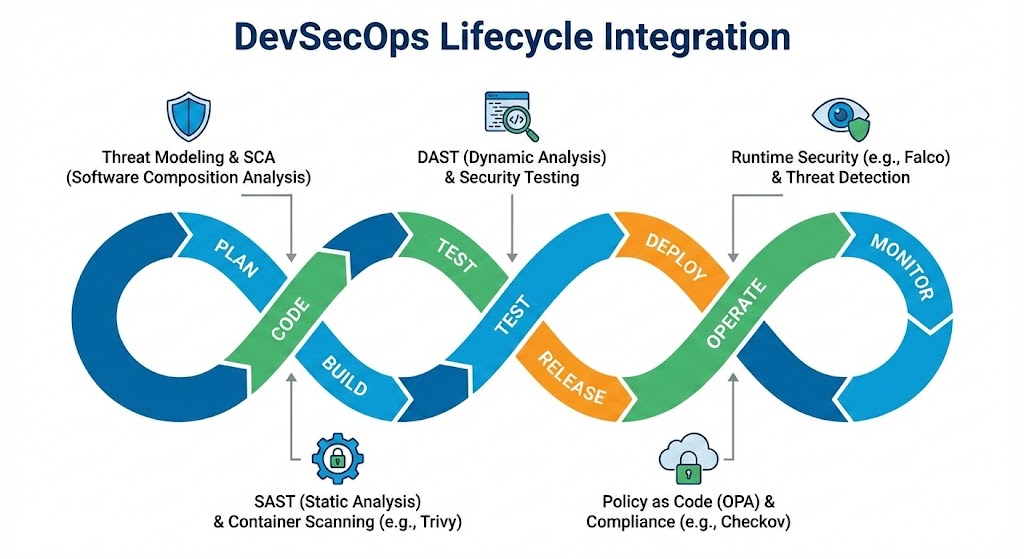
This dedicated path requires a deep dive into both offensive and defensive security techniques. Specifically, professionals must learn how to think like an attacker to build better automated defenses. Moreover, they should focus on the entire lifecycle, from pre-code threat modeling to post-deployment runtime protection. Additionally, mastering tools that provide “observability” into security events is crucial for this role. Effectively, the DevSecOps path creates a specialist who can design end-to-end secure delivery systems.
SRE Path
Site Reliability Engineers should view security through the lens of system availability and reliability. Notably, a security breach is often the most significant cause of unexpected downtime. Therefore, the SRE path focuses on runtime security monitoring and automated incident response. Specifically, they should learn how to use tools like Falco to detect anomalous behavior in production environments. Ultimately, integrating security into the SRE workflow ensures that the system remains both robust and resilient against malicious actors.
AIOps / MLOps Path
As organizations adopt machine learning, securing the ML pipeline becomes a critical requirement. Specifically, professionals in this path must protect the training data, the model code, and the deployment endpoints. Furthermore, they should learn how to detect “data poisoning” and model drift that could indicate a security compromise. Consequently, applying DevSecOps principles to MLOps ensures that AI models are not only accurate but also secure and compliant. Notably, this path represents the next frontier for security automation.
DataOps Path
Data engineers must prioritize the security of data at rest, in transit, and in use within their pipelines. Specifically, they should implement automated encryption, masking, and access control checks. Moreover, the DataOps path involves securing the ETL processes and the big data platforms like Snowflake or Databricks. Accordingly, integrating security into data workflows prevents costly leaks and ensures compliance with global privacy regulations. Essentially, this path builds a bridge between data utility and data protection.
FinOps Path
Security and cost management often go hand-in-hand, especially when dealing with cloud resources. Specifically, the FinOps path focuses on how orphaned or unpatched resources can lead to both security vulnerabilities and wasted spending. Furthermore, professionals should learn how to audit cloud bills for “crypto-jacking” or other unauthorized resource usage. Consequently, a secure cloud environment is typically a more cost-effective one. Ultimately, this path helps engineers optimize for both safety and financial efficiency.
Role → Recommended DevSecOps Certified Professional (DSOCP) Certifications
| Role | Recommended Certifications |
| DevOps Engineer | DSOCP Foundation, DSOCP Professional |
| SRE | DSOCP Professional, Runtime Security Specialist |
| Platform Engineer | DSOCP Advanced Infrastructure, OPA Specialist |
| Cloud Engineer | Cloud Security Specialty, DSOCP Foundation |
| Security Engineer | Full DSOCP Track, Pentesting Certifications |
| Data Engineer | Data Security Specialist, DSOCP Foundation |
| FinOps Practitioner | FinOps Certified, DSOCP Foundation |
| Engineering Manager | DevOps Leader, DSOCP Foundation |
Next Certifications to Take After DevSecOps Certified Professional (DSOCP)
Same Track Progression
Once you master the professional level, you should pursue the Expert level focusing on Runtime Security and Chaos Engineering for security. Specifically, this involves learning how to inject security failures to test the resilience of your monitoring systems. Furthermore, you can specialize in mobile application security or API security within the same framework. Consequently, deep specialization makes you an invaluable asset for organizations with high-security requirements. Ultimately, the same-track progression builds a vertical expertise that is hard to replace.
Cross-Track Expansion
Broadening your skills into Kubernetes or Cloud-specific security is a logical next step after DSOCP. Specifically, taking the Certified Kubernetes Security Specialist (CKS) exam complements the DSOCP knowledge perfectly. Moreover, exploring MLOps security or FinOps can open doors to niche industries that require multi-disciplinary experts. Accordingly, cross-track expansion prevents you from becoming a “one-tool” engineer. Notably, this strategy increases your flexibility in a volatile job market.
Leadership & Management Track
If you aim for leadership, focus on certifications that emphasize strategy, governance, and culture. Specifically, the DevOps Leader (DOL) or the Certified Information Security Manager (CISM) are excellent choices. Furthermore, you should learn how to communicate the ROI of security automation to non-technical stakeholders. Consequently, this transition allows you to move from “doing” the work to “defining” how the work is done. Ultimately, the leadership track prepares you for roles like VP of Engineering or CISO.
Training & Certification Support Providers for DevSecOps Certified Professional (DSOCP)
DevOpsSchool
DevOpsSchool provides comprehensive, instructor-led training specifically tailored for the DSOCP curriculum. Specifically, they offer extensive lab environments where students can practice real-world automation scenarios. Furthermore, their mentors bring decades of industry experience to help students navigate complex enterprise challenges.
Cotocus
Cotocus focuses on delivering high-quality corporate training for DevSecOps and cloud-native technologies. Notably, they specialize in customized workshops that align the DSOCP certification with a company’s specific toolchain. Consequently, their training is highly practical and immediately applicable to production environments.
Scmgalaxy
Scmgalaxy serves as a vast knowledge hub for SCM, DevOps, and DevSecOps professionals worldwide. Specifically, they provide a wealth of free resources, tutorials, and community support for those preparing for the DSOCP exam. Furthermore, their forums are an excellent place to discuss technical hurdles.
BestDevOps
BestDevOps offers a curated learning experience focused on the most modern and efficient DevOps practices. Specifically, their DSOCP preparation courses emphasize speed and efficiency in building secure pipelines. Moreover, they provide excellent practice tests that mirror the actual certification environment.
devsecopsschool.com
This platform is a dedicated resource for everything related to security automation and DevSecOps. Specifically, they host specialized bootcamps that cover the entire DSOCP syllabus in an intensive format. Furthermore, their focus on “only security” makes them a niche expert in this field.
sreschool.com
Sreschool.com integrates DevSecOps principles into the broader context of Site Reliability Engineering. Notably, they teach how to build secure, reliable systems that can withstand both traffic spikes and security attacks. Consequently, their training is ideal for engineers who manage large-scale infrastructure.
aiopsschool.com
Aiopsschool.com explores the intersection of Artificial Intelligence and IT Operations, including AI-driven security. Specifically, they provide insights into how machine learning can be used to detect and mitigate security threats automatically. Furthermore, their DSOCP support focuses on the future of automation.
dataopsschool.com
Dataopsschool.com addresses the unique security challenges of data pipelines and big data ecosystems. Notably, they help data professionals achieve DSOCP certification by focusing on data privacy and automated compliance. Consequently, their approach is essential for modern data-driven enterprises.
finopsschool.com
Finopsschool.com bridges the gap between cloud financial management and security automation. Specifically, they teach how to secure cloud spending and prevent unauthorized resource usage. Furthermore, their DSOCP training highlights the cost-saving benefits of a well-secured cloud environment.
Frequently Asked Questions (General)
- How difficult is it to pass the DSOCP certification? The difficulty level is moderate to high because it requires hands-on proficiency rather than just memorization. Specifically, candidates must demonstrate their ability to configure tools and fix broken pipelines in a lab environment. However, with consistent practice and a solid understanding of CI/CD concepts, an engineer can successfully pass the exam.
- How much time should I dedicate to preparing for the exam? Most professionals find that 30 to 60 days of dedicated study is sufficient for the professional level. Specifically, you should spend at least 10 hours per week practicing in a lab environment. Furthermore, beginners might need more time to master the underlying Linux and Docker concepts before diving into security tools.
- What are the main prerequisites for taking the DSOCP? Basic knowledge of Linux command-line operations and Git version control is essential. Additionally, you should understand the fundamentals of a DevOps pipeline and how containers like Docker work. Notably, while a security background is helpful, the course is designed to teach security to DevOps-minded professionals.
- Is there a high return on investment (ROI) for this certification? Absolutely, because DevSecOps engineers command some of the highest salaries in the current tech market. Specifically, organizations are willing to pay a premium for professionals who can protect their software supply chain. Furthermore, the certification significantly enhances your credibility during technical interviews for senior-level positions.
- In what order should I take the various DevSecOps certifications? You should start with the Foundation level to grasp the core concepts of SCA and SAST. Consequently, move to the Professional level to learn about DAST and container scanning. Ultimately, you can specialize in Advanced Infrastructure or Runtime Security based on your specific career goals and daily job responsibilities.
- How does DSOCP compare to cloud-specific security certifications? DSOCP is tool-agnostic and focuses on the logic of the pipeline, whereas cloud certs focus on specific vendor services. Specifically, DSOCP teaches you how to build a security culture that works on AWS, Azure, or on-prem. Therefore, it provides a broader foundation that you can apply across various cloud providers.
- Do I need to be an expert programmer to succeed in DevSecOps? You do not need to be a software architect, but you must be comfortable reading and writing scripts. Specifically, knowledge of YAML, Bash, and a bit of Python or Go is very helpful. Most of your work will involve configuring tools and writing policy as code rather than building complex applications.
- Can this certification help me transition from QA to DevOps? Yes, because many QA tasks are now being automated within the security domain of the pipeline. Specifically, your experience with testing methodologies provides a great foundation for Dynamic Application Security Testing (DAST). Consequently, learning DevSecOps is one of the most effective ways to pivot into a more technical operations role.
- Does the certification expire, and how do I renew it? Most professional certifications require renewal every two to three years to ensure your skills stay current. Specifically, you might need to take a delta exam or earn continuing education credits by attending workshops. Notably, keeping your certification active demonstrates your commitment to continuous learning in a fast-paced field.
- Are the labs included in the training program? Yes, the program provided by DevOpsSchool includes comprehensive hands-on labs that simulate real-world production environments. Specifically, these labs allow you to practice scanning real code and fixing real vulnerabilities without risking any actual systems. Furthermore, lab access is typically available for several months after the training.
- Is there a community or forum for DSOCP candidates? Indeed, platforms like Scmgalaxy and the official DevOpsSchool forums provide vibrant communities for students. Specifically, you can ask questions, share your lab experiences, and get advice from those who have already passed the exam. Consequently, being part of a community makes the learning process much more engaging.
- Can my company sponsor my DSOCP certification? Most enterprises have a training budget for security and cloud automation, so sponsorship is very common. Specifically, you should highlight how the certification will help the team reduce security risks and automate compliance. Furthermore, demonstrating the value of “shifting left” is usually enough to convince management to invest.
FAQs on DevSecOps Certified Professional (DSOCP)
- What specific tools are covered in the DSOCP curriculum? The curriculum covers a wide range of industry-standard tools including SonarQube, Snyk, Vault, Aqua Security, and OWASP ZAP. Furthermore, it includes container scanning tools like Trivy and infrastructure auditing tools like Checkov to ensure a well-rounded technical expertise.
- Does this certification focus more on tools or on culture? It provides a balanced approach by teaching the technical implementation of tools while emphasizing the “Security as Culture” mindset. Specifically, you learn how to bridge the communication gap between development and security teams effectively.
- Can I take the exam online from my home? Yes, the certification assessment is typically conducted online through a secure proctored environment for your convenience. Notably, you will need a stable internet connection and a computer capable of running the required lab environments.
- Is the DSOCP recognized globally by major tech firms? The DSOCP is highly regarded across the globe, especially by companies that prioritize cloud-native delivery and automated governance. Furthermore, many Indian multinational corporations actively seek DSOCP-certified professionals for their digital transformation projects.
- How does DevSecOps differ from traditional Cyber Security? Traditional security often happens at the end of the cycle, whereas DevSecOps integrates security into every single step. Specifically, DevSecOps focuses on automation and developer empowerment rather than manual gatekeeping and perimeter-based defenses.
- What is the passing score for the DSOCP exam? The passing criteria usually require you to complete a certain percentage of the lab tasks and score well on theory. Specifically, you must demonstrate that you can successfully secure a pipeline and remediate common vulnerabilities.
- Are there any mock tests available for practice? Yes, providers like BestDevOps offer simulated exams that mimic the format and difficulty of the actual DSOCP assessment. Consequently, taking these mock tests is an excellent way to identify your weak areas before the final attempt.
- Will this certification help me get a job in SRE? Absolutely, as security is a core pillar of modern site reliability and infrastructure management. Specifically, knowing how to automate security responses makes you a much more attractive candidate for high-level SRE positions in any enterprise.
Final Thoughts: Is DevSecOps Certified Professional (DSOCP) Worth It?
If you are looking for a way to stand out in a crowded market of DevOps engineers, then yes, this certification is worth your effort. Specifically, it proves that you possess the rare ability to balance speed with safety. While many engineers can build a pipeline, few can build one that is truly secure and compliant by design. Notably, the industry is moving toward a future where “DevOps” and “DevSecOps” will simply be the same thing. Consequently, getting certified now gives you a significant early-mover advantage. Ultimately, focus on the skills and the labs, and the career growth will naturally follow.