
Introduction
Imagine you finally decide to organize your business accounts or catch up on pending tax filings. You open your browser, search for professional help, and instantly find a long list of experts. Every professional profile seems similar at first glance. They all mention compliance work, tax filing, and business advisory services. Yet, their fee structures vary widely, and their backgrounds look completely different. Choosing the right professional from this crowded field can quickly feel overwhelming. Selecting a Chartered Accountant is not like buying a standard product off a shelf. Your financial records, tax compliance, and business growth depend heavily on the guidance you receive. Choosing a professional solely based on a low fee, a nearby office location, or a handful of online ratings often leads to mismatched expectations. Different professionals possess different strengths. Some focus primarily on individual income tax returns, while others specialize in complex corporate audits, international taxation, or GST compliance for e-commerce startups. Comparing multiple professionals before making a commitment helps you look beyond surface-level details. By evaluating professional qualifications, relevant industry experience, specific areas of expertise, service scopes, communication styles, and availability, you gain clarity on who best suits your requirements. Every financial situation is unique. A salaried professional with multiple investments needs a different type of support than a growing technology startup or a traditional retail business.
Understanding Your Requirements Before Comparing CAs
Before you start looking at profiles, you must clearly define what you actually need. Many people skip this step and start browsing directory listings right away. Without a clear idea of your own requirements, every professional profile looks equally attractive or equally confusing. Identifying your exact financial or accounting tasks narrows your focus and makes the entire comparison process much more productive. Different clients require very different services. A salaried individual might only need help with annual income tax filing and capital gains calculations. A freelancer or consultant may need assistance with quarterly tax payments, expense tracking, and GST registration. On the other hand, startup founders and growing business owners often require comprehensive bookkeeping, payroll management, regulatory filings, company registration, and periodic financial audits. Your business stage and transaction volume also dictate your needs. A retail shop with hundreds of daily cash transactions needs structured bookkeeping support that a service-based agency might not require. By writing down your specific goals, expected deadlines, and ongoing compliance needs, you create a checklist for evaluating potential professionals. When you know what you are looking for, you can immediately tell whether a particular Chartered Accountant has handled similar situations before. This initial self-assessment transforms you from a passive browser into an informed client who knows the right questions to ask during an initial consultation.
Where to Start When Looking for Chartered Accountants
Finding the right professional begins with knowing where to look. In the past, people relied entirely on word-of-mouth referrals from friends, family members, or business associates. While personal recommendations remain valuable, they often provide a very limited selection. You might end up working with someone simply because they happened to be convenient for a colleague, even if their specialization does not match your specific industry. Online professional directories and discovery platforms have changed how people find financial experts. These platforms allow you to search through a broad pool of professionals without relying on chance recommendations. Modern search filters let you narrow down your options based on specific criteria such as geographic location, professional specialization, spoken languages, available consultation modes, and years of professional practice. When exploring directory platforms, look for structured profile information that highlights a professional’s core practice areas rather than just general claims. BestCaNow serves as a dedicated platform where users can explore Chartered Accountant profiles and review essential details in one place. Using such a platform helps you assemble a shortlist of suitable candidates quickly.
Check Professional Qualifications and Credentials
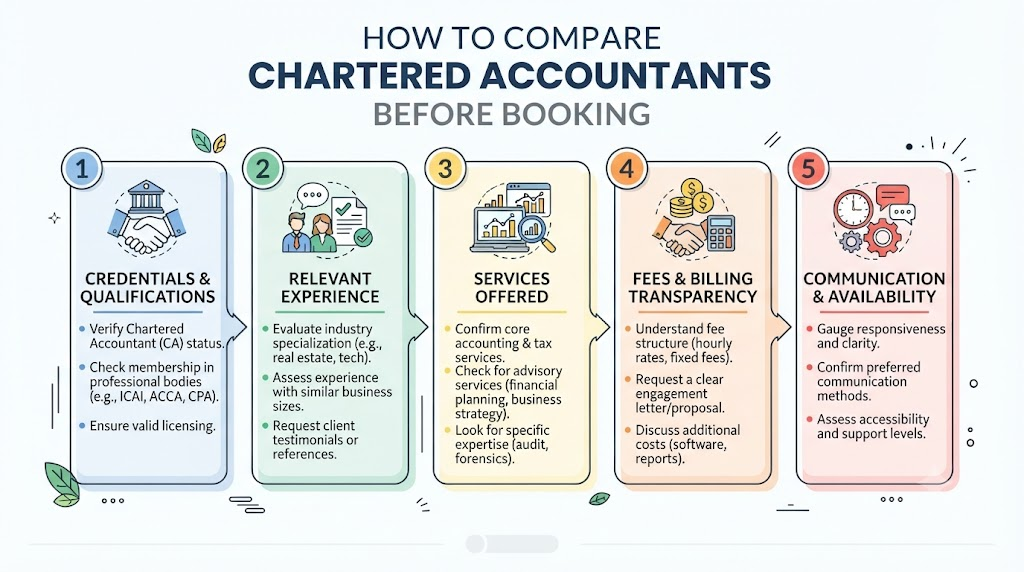
The foundation of any professional financial engagement is verified qualification. A Chartered Accountant title signifies rigorous education, comprehensive examinations, and adherence to strict professional standards. However, simply reading the letters “CA” on a profile is not enough when you are entrusting someone with sensitive financial data and legal compliance.You should always verify that a professional holds active membership with the relevant governing accounting body and maintains a valid certificate of practice. Official regulatory portals and professional registers allow you to check whether a practitioner’s credentials are current and in good standing. This simple verification step protects you from unqualified individuals offering unauthorized financial services. Reviewing credentials goes beyond basic membership. It includes understanding the specific certifications a professional holds. For instance, some practitioners obtain additional qualifications in information systems audit, indirect taxation, insolvency resolution, or valuation. If your business operates in a specialized sector, verifying these supplementary credentials ensures the professional possesses the necessary technical depth. Never skip this step out of haste. Checking credentials takes only a few minutes, but it provides vital peace of mind. Combine your independent verification with the details presented on their professional profile to confirm that the practitioner is fully qualified to handle your specific assignments.
Compare Relevant Experience Instead of Just Years in Practice
Many people assume that a practitioner with twenty years in practice is automatically better than someone with five years of experience. While general professional longevity indicates stability, relevant experience matters far more than mere chronological age or total years in practice. Consider two different professionals. One has spent fifteen years exclusively managing personal tax returns for salaried employees. The other has spent five years managing multi-state GST compliance, payroll, and corporate audits for manufacturing startups. If you run a growing software company, the second professional is far more relevant to your needs, despite having fewer total years in practice. Relevant experience means the professional has repeatedly solved problems similar to yours. If you are an e-commerce seller dealing with marketplace tax collection, cross-border transactions, and inventory accounting, you need someone who understands those exact operational hurdles. Asking about their past work with similar clients reveals whether they speak your business language. When comparing professionals, look closely at the types of industries, business models, and financial challenges they highlight in their backgrounds. Matching their actual hands-on experience to your current needs ensures a smoother working relationship and minimizes the learning curve.
Compare CA Specializations and Areas of Expertise
Chartered Accountancy is a vast field. While every qualified CA receives broad training across accounting, auditing, and taxation, practicing professionals frequently develop deep specializations over time. Expecting every practitioner to be an absolute expert in every niche is unrealistic. Common areas of specialization include direct taxation, indirect taxation like GST, corporate law compliance, international taxation, internal auditing, startup financial advisory, and bookkeeping management. A professional who spends most of their time advising corporate mergers will likely approach a small retail bookkeeping inquiry differently than a dedicated tax practitioner. You should examine how a professional’s core expertise aligns with your requirements. If your primary goal is optimizing business tax structures and maintaining flawless GST filings, prioritize practitioners who highlight tax and compliance advisory as their primary focus. A mismatch between your needs and a professional’s specialization often results in friction. The professional may need extra time to research unfamiliar regulations, or worse, overlook subtle compliance details. Reviewing specializations upfront ensures that you engage someone who operates comfortably within your required domain.
Compare the Services Offered by Different CAs
Service offerings can vary significantly from one Chartered Accountant to another. Some practitioners focus strictly on periodic compliance and statutory audits, while others provide comprehensive fractional CFO services, daily bookkeeping, payroll processing, and strategic financial planning. When comparing different professionals, examine the exact scope of services included in their standard offerings. For instance, if you are looking for income tax filing support, check whether the service covers capital gains calculations, foreign asset reporting, tax notices handling, and post-filing support, or if those items incur additional charges. For ongoing business services like bookkeeping and GST compliance, clarify the division of labor. Ask who enters daily transactions, how invoices are shared, how reconciliation is handled, and how often financial reports are delivered. Understanding these operational boundaries prevents misunderstandings later.
Compare CA Fees and Understand the Pricing Structure
Financial cost is naturally an important factor when choosing a service provider, but viewing fees in isolation is a common trap. CA fees vary based on the complexity of your financial records, transaction volumes, regulatory requirements, urgency, and the overall scope of services.
Professional fee structures typically fall into a few common categories:
- Fixed Fees: Standardized pricing for defined, one-time tasks such as filing an annual tax return or registering a new business entity.
- Project-Based Charges: Customized quotes for complex assignments like conducting a financial audit or restructuring corporate debt.
- Periodic Service Fees: Monthly or quarterly retainers for ongoing bookkeeping, GST filing, and routine compliance support.
- Consultation Charges: Fees charged for a dedicated advisory session where you discuss specific tax strategies or business questions.
When comparing pricing, always ask for a clear breakdown of what is included. The lowest quoted price may exclude essential tasks such as responding to tax department notices or preparing supplementary financial statements. Requesting transparent fee quotations from multiple professionals helps you evaluate costs fairly and avoid unexpected expenses down the line.
Check Consultation Modes Before Booking
The way you interact with your Chartered Accountant has a direct impact on convenience and efficiency. Modern professional practices offer multiple consultation modes, ranging from traditional face-to-face meetings at an office to fully remote digital consultations via video calls, phone calls, and secure messaging portals. Each consultation mode offers distinct advantages. In-person meetings can feel more reassuring for complex corporate restructuring or sensitive financial discussions where physical documents need thorough examination. On the other hand, online consultations save travel time, make scheduling easier, and allow you to share digital documents instantly without disrupting your workday. Your choice of consultation mode often depends on your personal comfort, geographic proximity, and the complexity of the financial matter. If you prefer working entirely online, you need to ensure the professional is comfortable using digital document-sharing tools and conducting structured video conferences. Platforms like BestCaNow display available consultation modes on professional profiles, allowing you to filter practitioners based on whether they offer online meetings, in-person consultations, or both. Selecting a practitioner whose communication setup matches your preferences ensures a comfortable and productive working relationship.
Compare Availability and Appointment Flexibility
Timing is everything in the world of accounting and taxation. Statutory filing deadlines, tax audit due dates, GST submission cycles, and business review periods leave very little room for delay. A brilliant Chartered Accountant who has no available appointment slots until next month will not help you meet an urgent tax deadline today. When comparing professionals, check their current availability and expected response times. Ask how far in advance appointments need to be booked and what their turnaround time is for completing routine reviews or answering urgent queries during peak filing seasons. It is also important to distinguish between booking an initial consultation slot and securing a commitment to complete an entire project by a specific deadline. An available consultation slot means you can talk to the professional soon, but you still need to confirm whether their operational bandwidth allows them to take on your entire workload within your required timeframe. Choosing a professional with realistic availability and reliable communication habits ensures your financial tasks progress smoothly without last-minute panic or missed deadlines.
Evaluate Communication and Language Preferences
Accounting involves numbers, but working with a Chartered Accountant relies entirely on clear human communication. Tax laws, compliance regulations, and financial statements can be notoriously difficult to understand for non-financial professionals. The right Chartered Accountant is not just someone who calculates numbers correctly, but someone who can explain complex financial concepts in plain, understandable language. During your initial interactions, pay attention to how clearly the professional answers your questions. Do they listen carefully to your situation, or do they rush through standardized explanations filled with heavy jargon? Language preferences also play a vital role in ensuring clarity. Discussing intricate financial matters in your preferred language helps prevent misunderstandings and builds mutual trust. Additionally, clarify how routine communication is handled—whether they prefer scheduled email updates, quick messaging apps, or structured phone calls. Finding a professional whose communication style matches your expectations makes financial management feel collaborative rather than intimidating.
Review CA Profiles Carefully Before Booking
Reviewing a Chartered Accountant’s profile is the practical step where all your research criteria come together. A well-constructed professional profile provides a comprehensive snapshot of who the practitioner is, what they specialize in, and how they operate.
When you examine a profile, look systematically at the following elements:
- Professional Background: Educational qualifications, certifications, and verified practice credentials.
- Specialization Areas: Primary domains of practice such as taxation, auditing, or business advisory.
- Relevant Experience: Industry focus and types of client entities handled in the past.
- Consultation Modes: Availability of online video meetings, phone calls, or in-person office visits.
- Spoken Languages: Comfort and fluency in communication preferences.
- Location and Availability: Office presence and current appointment flexibility.
Treat profile information as your foundational starting point. If any detail regarding their service scope or experience appears unclear, make a note to ask the professional directly during your initial consultation before finalizing any engagement.
Understand the Importance and Limitations of Online Reviews
Online reviews and client testimonials offer valuable windows into a professional’s service quality, punctuality, and client care. Reading what past clients say can give you a good sense of whether a practitioner is responsive, polite, and thorough in their work. However, reviews come with inherent limitations. A glowing five-star rating from a salaried individual who needed a simple tax return filed does not guarantee that the same professional is equipped to handle a complex international tax audit for a growing tech company. Conversely, a single negative review might stem from a client who missed deadlines or failed to provide necessary documents. Use reviews as contextual background rather than absolute proof of suitability. Look for recurring themes in feedback—such as clear communication, reliability, and attention to detail—and weigh those observations alongside hard facts like professional credentials, relevant experience, and direct conversations.
Compare Two or More Chartered Accountants Side by Side
Comparing multiple professionals side by side prevents emotional decision-making and helps you evaluate your options objectively. When you rely solely on memory after browsing several profiles, details tend to blur together, making it difficult to remember who offered what. Using a consistent set of criteria for every professional on your shortlist brings clarity to the process. Record key details such as their core specialization, relevant industry experience, service inclusions, fee estimates, consultation modes, and availability. The practical comparison table below provides a structured framework to help you organize your findings and evaluate your shortlisted candidates effectively.
| Comparison Factor | CA A | CA B | CA C |
| Relevant Specialization | To be checked | To be checked | To be checked |
| Relevant Experience | To be checked | To be checked | To be checked |
| Services Offered | To be confirmed | To be confirmed | To be confirmed |
| Consultation Fee | To be confirmed | To be confirmed | To be confirmed |
| Consultation Mode | To be checked | To be checked | To be checked |
| Availability | To be confirmed | To be confirmed | To be confirmed |
| Communication Preference | To be discussed | To be discussed | To be discussed |
| Additional Charges | To be confirmed | To be confirmed | To be confirmed |
Note: You can fill in this table using information gathered from shortlisted professional profiles and direct consultations.
Questions to Ask Before Booking a CA Consultation
An initial consultation is your opportunity to interview the Chartered Accountant just as much as they are evaluating your financial requirements. Walking into a meeting with a prepared list of questions ensures you cover all important aspects before committing to an engagement.
How to Compare Online and In-Person CA Consultations
Choosing between online and in-person consultations depends largely on your personal comfort, geographical convenience, and the complexity of your financial paperwork. Neither mode is universally superior; each serves different needs. In-person meetings offer the comfort of face-to-face interaction, which many business owners prefer when discussing sensitive financial planning, corporate restructuring, or complex tax disputes. Sitting across a desk allows both parties to review physical ledgers, signed physical documents, and legal deeds together. Online consultations offer unmatched efficiency and flexibility. They eliminate travel time, making it easy to connect with specialized professionals regardless of physical distance. Secure screen sharing makes reviewing digital spreadsheets, bank statements, and tax portals seamless. Evaluate your own comfort level and the nature of your documents. If your records are entirely digital and you value flexible scheduling, online consultations are an ideal choice. If you prefer traditional meetings for complex matters, look for practitioners offering office consultations.
How BestCaNow Helps Users Compare Chartered Accountants
Navigating the financial services landscape requires reliable tools that bring clarity to your search. BestCaNow was built to simplify how individuals and business owners discover and compare Chartered Accountants. The platform provides structured professional profiles that highlight essential details such as areas of specialization, professional background, years of practice, spoken languages, and available consultation modes. Instead of searching across unverified sources, users can explore organized profiles in one centralized location. Search and filter tools allow you to narrow down professionals based on your specific requirements, whether you need income tax filing, GST support, or startup advisory services. You can review profile details, check available consultation options, and submit appointment requests directly through the platform. While discovery tools streamline the initial research phase, the final decision always rests with you. BestCaNow helps make the discovery process transparent and organized, allowing you to connect with qualified professionals who match your financial needs.
| Comparison Factor | What to Check | Why It Matters |
| Professional credentials | Membership and relevant qualifications | Helps establish professional eligibility |
| Relevant experience | Experience related to the required service | Helps assess suitability for the assignment |
| Specialization | Tax, GST, audit, accounting, or advisory expertise | Helps match the professional to the client’s needs |
| Service scope | Included tasks and exclusions | Prevents misunderstandings about deliverables |
| Fees | Consultation charges and service pricing | Helps compare costs fairly |
| Availability | Appointment slots and expected response times | Helps with planning and deadlines |
| Consultation mode | Online, in-person, or both | Supports the client’s preferred meeting method |
| Communication | Language and explanation style | Makes discussions easier to understand |
| Reviews | Relevant and available client feedback | Offers additional context about past experiences |
The Booking Process After Comparing Chartered Accountants
Once you have reviewed shortlisted profiles, compared their service offerings, and narrowed down your choice, the final booking process should be straightforward. Taking methodical steps ensures a smooth transition from research to active engagement. First, review your preferred professional’s profile and check their available consultation slots. Submit an appointment request indicating your primary requirement, whether it is income tax filing, GST advisory, or business accounting support. Before confirming the appointment, verify the consultation fee, if any, and note what documents you need to prepare for the meeting. Once the appointment is confirmed, organize your financial statements, bank records, and previous tax filings so you can make the most of your scheduled consultation time.BestCaNow streamlines this appointment request workflow, allowing you to initiate contact with verified professionals easily and set up your consultation without unnecessary friction.
Common Mistakes to Avoid When Comparing CAs
When comparing financial professionals, it is easy to fall into common traps that lead to poor choices. Being aware of these pitfalls helps you navigate the selection process more effectively.
- Choosing Solely by Price: Picking the cheapest quotation often results in hidden fees, rushed compliance work, or a lack of post-filing support when tax notices arrive.
- Ignoring Specialization: Hiring a general practitioner for highly specialized corporate tax or international compliance work can lead to costly errors and missed opportunities.
- Overlooking Credentials: Failing to verify active professional membership and practice credentials can expose you to unqualified service providers.
- Relying Entirely on Reviews: Treating ratings as absolute proof of suitability without checking actual experience or service scope can lead to a mismatch.
- Skipping Service Scope Clarification: Assuming all necessary tasks are included in a fee quote without asking specific questions about deliverables.
Keeping these common mistakes in mind ensures you evaluate professionals based on a well-rounded set of criteria rather than reacting to surface-level impressions.
Choosing a CA Based on Your Specific Needs
Every client approaches professional financial services with a distinct set of priorities. A salaried professional looking for quick, accurate income tax filing has very different needs from a startup founder building a scalable business structure from scratch. Freelancers and independent consultants often require ongoing guidance on deductible business expenses, quarterly tax advance payments, and GST compliance. Business owners need robust bookkeeping, payroll management, statutory audits, and strategic financial forecasting. Complex assignments require specialized professional experience and dedicated advisory support. Recognizing your own specific requirements helps you prioritize the comparison factors that matter most to you. Ultimately, the right Chartered Accountant is the one whose verified credentials, relevant experience, transparent service scope, and communication style match your actual financial needs.
Frequently Asked Questions
1. How do I compare Chartered Accountants before booking?
Comparing Chartered Accountants involves evaluating their professional qualifications, relevant industry experience, specific areas of expertise, service scopes, fee structures, consultation modes, and availability side by side using a structured approach.
2. What should I check in a CA’s professional profile?
You should check educational credentials, active practice membership, core specializations, relevant past experience, spoken languages, available consultation modes, and office locations.
3. How important is experience when choosing a Chartered Accountant?
Relevant experience is crucial because it ensures the professional has successfully handled financial tasks, tax matters, or compliance challenges similar to your specific situation.
4. Should I compare CA fees before booking a consultation?
Yes, comparing fee structures helps you understand what is included in the quotation, distinguishing between basic filings, ongoing bookkeeping, and additional advisory charges.
5. How can I check a CA’s specialization?
You can review their professional profile descriptions, inquire about their primary client types during an initial consultation, and check their experience in fields like direct tax, GST, or auditing.
6. Is an online CA consultation suitable for businesses?
Online consultations are highly suitable for businesses that manage digital records, value flexible scheduling, and prefer instant document sharing over in-person office visits.
7. What questions should I ask before booking a CA?
You should ask about their relevant experience, service inclusions, fee breakdowns, document requirements, turnaround timelines, and preferred communication methods.
8. Are online reviews enough to choose a Chartered Accountant?
Online reviews provide helpful context about past client experiences, but they should be considered alongside verified professional credentials, relevant experience, and direct discussions.
9. How can I compare multiple CAs at the same time?
You can use a structured comparison checklist or a side-by-side comparison table to record and evaluate each professional’s qualifications, services, fees, and availability.
10. How does BestCaNow help users compare Chartered Accountants?
BestCaNow provides a searchable directory platform where users can explore verified professional profiles, filter experts by location and specialization, and request consultations easily.
Conclusion
Choosing the right financial professional is an important decision that impacts your personal taxes, business compliance, and long-term financial health. Relying solely on low fees, proximity, or ratings often leads to mismatched expectations. By taking the time to compare Chartered Accountants based on verified credentials, relevant industry experience, specific specializations, transparent service scopes, fees, and communication styles, you make an informed choice tailored to your actual requirements. Platforms like BestCaNow make this discovery and comparison process streamlined and organized, allowing you to explore professional profiles and request consultations with confidence. Review your requirements, organize your documents, and take the first step toward finding a trusted Chartered Accountant today.