
Introduction
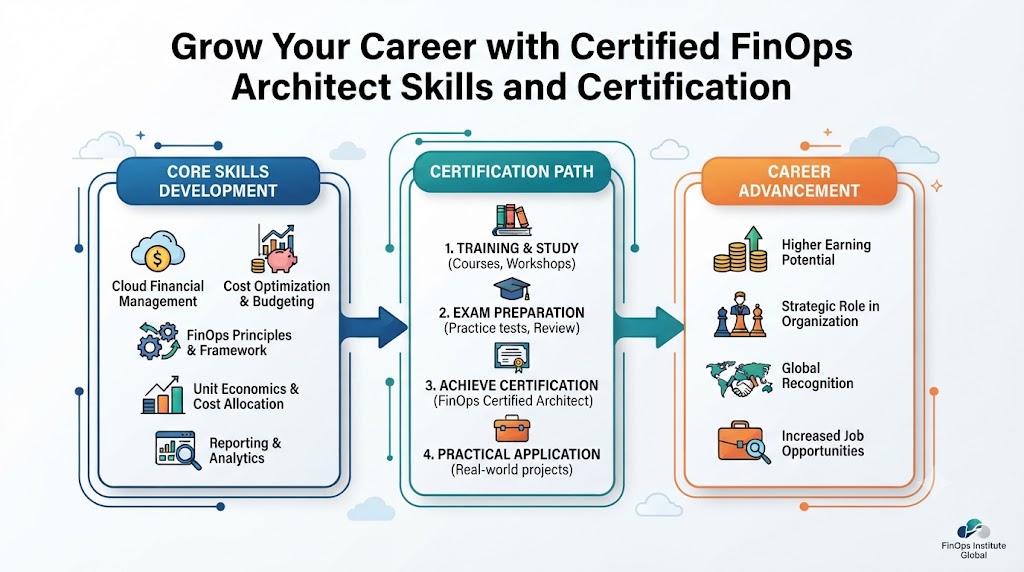
In the current era of cloud-first engineering, technical competence goes far beyond launching workloads and ensuring high availability. Professionals must now balance every architectural decision with financial accountability and resource optimization. The Certified FinOps Architect program is built precisely to close this gap between heavy cloud infrastructure and business finance. Delivered through FinOpsSchool, this rigorous credential proves your capability to engineer cost-efficient cloud systems at enterprise scale. This guide serves developers, cloud architects, and site reliability engineers who want to integrate financial discipline into their engineering workflows. We will examine how this credential transforms your professional standing within the platform engineering sector. Grasping this fusion of technical architecture and cost management enables professionals to make strategic, data-driven career choices.
What is the Certified FinOps Architect?
The Certified FinOps Architect represents a specialized discipline dedicated to driving maximum business value from cloud infrastructure investments. It exists because organizations migrated swiftly to the cloud only to face unpredictable, decentralized, and spiraling operational expenditures. This credential emphasizes practical, production-oriented learning over abstract financial theories and complex textbooks.
It integrates seamlessly with modern engineering pipelines, embedding cost management directly into infrastructure-as-code and continuous deployment workflows. By verifying these competencies, the credential ensures that enterprise platforms prioritize financial optimization right alongside performance and uptime.
Who Should Pursue Certified FinOps Architect?
This learning track strongly benefits engineers, reliability specialists, and cloud administrators who design and maintain large-scale environments. Security and data practitioners also gain immense value, as their pipelines frequently consume heavy compute cycles requiring strict budgetary boundaries. Both newcomers entering cloud governance and veteran engineers aiming to distinguish themselves will find profound relevance here.
Technical leaders and engineering managers should also target this credential to improve forecasting precision and foster a cost-conscious engineering culture. It delivers broad international value while directly addressing the cost efficiency demanded across the technology landscape in India.
Why Certified FinOps Architect
Enterprise reliance on cloud infrastructure continues to expand, triggering a relentless demand for specialists who can eliminate operational waste. Companies actively search for architects who can deploy automated cost controls, creating a remarkably stable and resilient career trajectory. This certification ensures professionals remain valuable regardless of which cloud provider or orchestration tool dominates tomorrow’s market.
Because financial operations principles apply universally across major cloud providers, the capabilities you acquire guarantee long-term career durability. The return on investment for your time and professional growth is substantial, as engineers who successfully reduce overhead are consistently retained and rewarded.
Certified FinOps Architect Certification Overview
The structured educational program is delivered through the official Certified FinOps Architect course portal hosted directly on FinOpsSchool. It offers a comprehensive methodology for managing cloud finances, ensuring candidates master both the technical architecture and financial reporting aspects. The certification is segmented into distinct tiers to accommodate varying levels of practical experience and technical responsibility.
Evaluations are exceptionally hands-on, requiring candidates to resolve authentic cost-efficiency challenges rather than relying solely on memorized multiple-choice answers. The overarching structure guarantees that the credential stays aligned with shifting enterprise requirements and actual production environments.
Certified FinOps Architect Certification Tracks & Levels
The certification roadmap features foundation, professional, and advanced tiers designed to support continuous professional development. The foundation tier establishes essential vocabulary and fundamental cost concepts, while the professional tier addresses pipeline automation and resource rightsizing. The advanced architect tier concentrates on enterprise governance, predictive forecasting, and multi-cloud financial strategies.
Specialized paths connect financial practices directly with DevOps, SRE, and data engineering workloads to deepen your expertise. This tiered design demonstrates how each level matches your career advancement from an individual contributor to an enterprise strategist.
Complete Certified FinOps Architect Certification Table
| Track | Level | Who it’s for | Prerequisites | Skills Covered | Recommended Order |
|---|---|---|---|---|---|
| Core FinOps | Foundation | Cloud beginners, Junior DevOps | Basic cloud knowledge | Cloud pricing models, Billing visibility | 1 |
| Core FinOps | Professional | SREs, Cloud Engineers | Foundation Certification | Tagging strategies, Rightsizing, Automation | 2 |
| Enterprise FinOps | Advanced | Cloud Architects, Managers | Professional Certification | Multi-cloud forecasting, Unit economics | 3 |
| DevOps Specialization | Professional | CI/CD Engineers, Platform teams | Pipeline creation knowledge | Cost-as-code, CI/CD budget guardrails | 4 |
| DataOps Specialization | Professional | Data Engineers, ML Ops | Basic data pipeline knowledge | Storage optimization, Query cost tuning | 5 |
Detailed Guide for Each Certified FinOps Architect Certification
Certified FinOps Architect – Foundation
What it is This certification validates a baseline understanding of cloud pricing structures, billing data exports, and fundamental cost allocation mechanics. It acts as the primary gateway for grasping how daily cloud consumption influences broader corporate finances.
Who should take it Junior cloud engineers, financial analysts transitioning into tech, and developers seeking baseline visibility into cloud expenses should take this. It requires minimal technical prerequisites, focusing primarily on core concepts and structural vocabulary.
Skills you’ll gain
- Interpreting and parsing detailed cloud billing statements.
- Comparing on-demand, reserved, and spot pricing models.
- Deploying standard resource tagging conventions.
- Articulating cloud expenditures clearly to non-technical leadership.
Real-world projects you should be able to do
- Create a daily cloud spend tracking dashboard using provider tools.
- Perform a routine audit to find unattached storage volumes.
- Draft an initial resource tagging policy document for a development group.
Preparation plan Dedicate 7 to 14 days to mastering cloud calculators and billing report layouts. Over 30 days, construct operational dashboards within a sandbox cloud environment. By 60 days, review foundational case studies and complete practice assessments to test your readiness.
Common mistakes Candidates frequently memorize definitions without understanding how distinct pricing tiers interact in complex architectures. Many also neglect the communication skills tested heavily throughout the foundational curriculum.
Best next certification after this
- Same-track option: Certified FinOps Architect – Professional.
- Cross-track option: A fundamental cloud provider certification.
- Leadership option: Project management credentials focusing on agile sprint integration.
Certified FinOps Architect – Professional
What it is This credential demonstrates your ability to build automated cost safeguards and optimize active production infrastructure effectively. It bridges the gap between simply spotting financial waste and actively writing code to remove it.
Who should take it Active DevOps engineers, site reliability specialists, and cloud administrators responsible for daily infrastructure maintenance. It is tailored for practitioners who possess the access permissions required to modify production environments.
Skills you’ll gain
- Automating instance scheduling and resource rightsizing workflows.
- Deploying spot instance fleets for fault-tolerant workloads.
- Developing infrastructure-as-code templates with integrated cost checks.
- Managing discount vehicles like Savings Plans and Reserved Instances.
Real-world projects you should be able to do
- Write automated scripts to terminate idle non-production environments after hours.
- Refactor a microservice layout to leverage spot computing safely.
- Implement CI/CD pipeline steps that block overly expensive infrastructure deployments.
Preparation plan Spend the first 14 days exploring infrastructure-as-code frameworks and cost estimation plugins. Over 30 days, build scripts to automate instance management and scheduled cleanup tasks. Use the 60-day milestone to master commitment discount break-even calculations.
Common mistakes Engineers often over-automate without factoring in the operational risks of rigid commitment plans. Another frequent error is overlooking the performance consequences of aggressive resource rightsizing.
Best next certification after this
- Same-track option: Certified FinOps Architect – Advanced.
- Cross-track option: Container administration credentials for Kubernetes optimization.
- Leadership option: Advanced cloud architecture design programs.
Certified FinOps Architect – Advanced
What it is This expert certification validates mastery of enterprise-scale financial management, predictive forecasting, and cross-functional leadership. It verifies that you can align engineering execution with overarching corporate financial targets.
Who should take it Principal engineers, enterprise architects, and engineering managers overseeing large multi-million dollar cloud budgets. It is built explicitly for senior leaders who guide organizational strategy rather than hands-on coding tasks.
Skills you’ll gain
- Constructing predictive models for accurate cloud spend forecasting.
- Establishing meaningful unit economics metrics for business units.
- Designing automated anomaly detection systems across multi-cloud setups.
- Leading cultural transformations toward decentralized cost ownership.
Real-world projects you should be able to do
- Build a comprehensive chargeback framework mapping costs directly to product revenue.
- Implement custom telemetry metrics to evaluate cloud spend against corporate growth.
- Lead a cross-functional task force to remediate a critical billing spike quickly.
Preparation plan Spend 14 days studying advanced data analytics and predictive modeling techniques. Over 30 days, design complex multi-cloud architecture and billing diagrams. Dedicate the 60-day mark to mastering change management and executive communication practices.
Common mistakes Candidates routinely underestimate non-technical challenges, such as negotiating with finance departments and changing team behaviors. They also struggle with multi-cloud data inconsistencies.
Best next certification after this
- Same-track option: Specialized cloud vendor expert certifications.
- Cross-track option: Executive leadership or corporate finance management courses.
- Leadership option: Advanced organizational leadership credentials.
Choose Your Learning Path
DevOps Path
The DevOps path emphasizes embedding cost checks directly into continuous integration and deployment pipelines. You will learn to utilize specialized tools to catch expensive infrastructure configurations before production deployment. This ensures that delivery speed remains high while maintaining strict budget boundaries. It represents an ideal route for automation engineers wanting to enforce policy as code.
DevSecOps Path
This path merges cloud financial operations with security compliance and vulnerability tracking. You will analyze the financial overhead associated with security logging, data transfer, and compliance storage rules. It teaches you how to design secure architectures that do not accidentally inflate monthly cloud bills. Security professionals will find this valuable for defending tool investments to executives.
SRE Path
Site Reliability Engineers will concentrate on balancing system availability against infrastructure expenses. This path covers the financial impact of multi-region redundancy, active-active setups, and autoscaling policies. You will learn to calculate the true cost of an extra availability nine and communicate it to stakeholders. It empowers reliability teams to make informed choices during design phases.
AIOps Path
This path centers on leveraging artificial intelligence to identify and resolve cost anomalies in real time. You will learn to train models on billing telemetry to forecast spikes and detect inefficient resource usage. It requires a solid grasp of both telemetry data and machine learning operations. Engineers following this path build self-optimizing, highly efficient infrastructure systems.
MLOps Path
The MLOps track focuses on managing the substantial costs linked to training and serving machine learning models. You will concentrate on GPU utilization, large dataset storage costs, and optimal inferencing hardware. This represents one of the most expensive domains in cloud computing, making the skill set highly lucrative. It helps data teams transition models into production without budget overruns.
DataOps Path
DataOps practitioners will focus on streamlining data lakes, data warehouses, and analytics pipelines. You will learn data lifecycle strategies, such as migrating cold data to cheaper storage tiers automatically. The path also covers query optimization, preventing poorly tuned big data queries from generating massive bills. It keeps data accessible and valuable without unnecessary overhead.
FinOps Path
The pure FinOps path targets the business logic, reporting, and cultural aspects of cloud financial management. You will collaborate with finance teams to deploy chargeback models, showback dashboards, and discount plans. This route focuses on strategic planning and leadership rather than writing code. It suits professionals eager to bridge the gap between engineering and finance.
Role → Recommended Certified FinOps Architect Certifications
| Role | Recommended Certifications |
|---|---|
| DevOps Engineer | Certified FinOps Architect – Foundation, DevOps Specialization |
| SRE | Certified FinOps Architect – Professional, SRE Track |
| Platform Engineer | Certified FinOps Architect – Professional, Enterprise Automation |
| Cloud Engineer | Certified FinOps Architect – Foundation, Professional |
| Security Engineer | Certified FinOps Architect – DevSecOps Specialization |
| Data Engineer | Certified FinOps Architect – DataOps Specialization |
| FinOps Practitioner | Certified FinOps Architect – Advanced |
| Engineering Manager | Certified FinOps Architect – Advanced, Leadership Track |
Next Certifications to Take After Certified FinOps Architect
Same Track Progression
Advancing along the same track involves pursuing expert-level credentials within the financial operations ecosystem. This deep specialization establishes you as the recognized subject matter expert on cost architecture within your enterprise. It equips you to manage increasingly intricate multi-cloud environments with total confidence.
Cross-Track Expansion
Cross-track expansion involves broadening your expertise by acquiring deep technical certifications from specific cloud vendors. Adding advanced networking or security credentials to financial governance creates a rare and powerful professional profile. This broadening approach ensures you understand the underlying engineering mechanics behind your optimizations.
Leadership & Management Track
Transitioning into leadership requires shifting away from day-to-day configuration tasks toward people and business administration. Pursuing credentials in agile leadership, enterprise architecture, or formal business education facilitates this shift. This track prepares you for executive roles like Vice President of Infrastructure.
Training & Certification Support Providers for Certified FinOps Architect
DevOpsSchool
DevOpsSchool stands out as a premier destination for mastering cloud financial operations through highly immersive, instructor-led training models. They focus extensively on bridging the gap between theoretical knowledge and practical, hands-on pipeline execution. Their curriculum is strictly aligned with the core demands of enterprise IT environments, ensuring students learn skills they can apply on day one. By blending real-world case studies with deep technical labs, they prepare engineers to handle complex cost optimization challenges confidently. DevOpsSchool is particularly known for its strong community support, offering continuous mentorship that extends well beyond the final certification exam.
Cotocus
Cotocus brings a specialized consulting approach to their certification training, heavily emphasizing enterprise-scale optimization techniques and workflows. Their trainers are active industry practitioners who bring immediate, real-world cloud billing crises into the classroom for students to solve. They excel at teaching the organizational and cultural shifts required to implement cost governance across massive, decentralized engineering teams. Cotocus provides custom lab environments that simulate messy, unoptimized enterprise architectures, forcing candidates to identify and remediate waste practically. Their program is ideal for senior professionals aiming to lead organizational change.
Scmgalaxy
Scmgalaxy provides a heavily community-driven training experience, deeply integrated with modern configuration management and infrastructure-as-code principles. They excel at demonstrating how cost optimization can be automated directly through tools like Terraform, Ansible, and Kubernetes. Their curriculum is aggressively updated to reflect the latest shifts in cloud pricing models and open-source tooling ecosystems. Scmgalaxy emphasizes peer-to-peer learning, encouraging students to collaborate on complex architectural challenges and share optimization scripts. This provider is a fantastic choice for deeply technical engineers who want to automate financial operations completely.
BestDevOps
BestDevOps focuses on accelerating the learning curve for professionals who need to master financial operations rapidly and efficiently. Their training modules are broken down into highly digestible, focused segments that accommodate the busy schedules of working engineers. They place a strong emphasis on continuous integration and how to build budget guardrails directly into deployment pipelines. BestDevOps utilizes extensive practice exams and scenario-based testing to ensure candidates are fully prepared for certification pressures. Their practical approach guarantees that students understand both the mechanics of cloud billing and the engineering required to fix it.
devsecopsschool.com
This provider takes a unique approach by strictly aligning cloud financial operations with rigorous security and compliance frameworks. They teach students how to optimize infrastructure without accidentally exposing environments to vulnerabilities or violating strict data governance laws. Their labs often feature scenarios where candidates must reduce costs while maintaining encrypted storage and high-availability security logging. This niche focus is incredibly valuable for professionals working in highly regulated industries like banking or healthcare. They ensure that cost-cutting measures never compromise the security posture of the enterprise.
sreschool.com
Focused entirely on the reliability engineering perspective, this provider teaches candidates how to balance infrastructure costs with strict Service Level Objectives. They dive deep into the mathematics of availability, helping engineers calculate the exact financial cost of achieving different tiers of uptime. Their training covers advanced autoscaling optimization, multi-region database cost management, and efficient disaster recovery architecture. This provider is the definitive choice for professionals who need to ensure maximum system resilience while adhering to tight corporate budgets. They bridge the gap between operational excellence and financial responsibility.
aiopsschool.com
This highly advanced provider focuses on the intersection of artificial intelligence and automated cloud financial management systems. They train engineers to implement machine learning models that can predict cost anomalies, forecast future budgets, and automatically scale down wasted resources. Their curriculum goes far beyond basic reporting, teaching candidates how to build self-healing infrastructure that actively optimizes its own costs. The coursework demands a strong technical background and is geared toward forward-thinking platform engineers. It is perfect for organizations dealing with massive scale where manual cost optimization is no longer mathematically possible.
dataopsschool.com
DataOpsSchool targets the massive, often uncontrollable costs associated with big data processing, analytics pipelines, and data warehousing. They teach specific strategies for optimizing query performance, managing data lifecycle tiers, and rightsizing massive computational clusters. Their scenarios focus heavily on popular data tools and how poor architectural choices in data lakes can lead to catastrophic billing surprises. This provider is essential for data engineers and ML professionals who consume vast amounts of cloud compute and storage. They ensure that data remains a corporate asset rather than an unmanageable financial liability.
finopsschool.com
As the core provider and official hosting platform, this organization delivers the most authoritative and comprehensive curriculum available for this credential. Their training covers the entire spectrum of financial operations, from foundational billing concepts to executive-level forecasting and chargeback strategy. They provide the most up-to-date certification blueprints, exclusive practice environments, and direct insights into industry best practices. Their programs are designed to accommodate everyone from junior developers to C-level executives looking to understand cloud economics. Choosing the official provider guarantees absolute alignment with the certification exams and modern enterprise standards.
Frequently Asked Questions
1. What foundational knowledge is required before starting this certification path?
Candidates should understand basic cloud architecture, including compute instances, storage volumes, and network routing. While foundational levels require no complex coding, professional tiers expect familiarity with cloud consoles and deployment tools.
2. How much weekly study time is needed to prepare for the foundation exam?
Most working engineers successfully prepare within 30 to 45 days by dedicating five to seven hours each week to studying billing structures and cost principles.
3. Is this curriculum tied exclusively to Amazon Web Services?
No, the syllabus is cloud-agnostic, teaching concepts that apply equally across Azure, Google Cloud, and AWS. Minor terminology differences between providers are covered during training.
4. Do I need programming experience to pass the professional level?
Advanced software development skills are not required, but you must understand infrastructure-as-code basics and how automation scripts manage resources.
5. How does this differ from traditional cloud architecture credentials?
Standard certifications focus primarily on uptime, security, and scalability. This track focuses specifically on the financial impact of those design decisions, teaching cost efficiency.
6. Can this credential help finance professionals transition into tech roles?
Yes, it serves as an excellent bridge for finance specialists entering the technology sector by pairing existing fiscal skills with technical cloud mechanics.
7. Is it acceptable to skip the foundation tier and take advanced exams?
Following the structured path is strongly advised, as advanced exams assume complete mastery of core allocation and tagging concepts.
8. Are the examinations multiple-choice or lab-based?
Foundation exams utilize scenario-based multiple-choice questions, while advanced tiers incorporate practical architectural analyses and billing evaluations.
9. How often must professionals recertify to keep their credential active?
Renewals are typically required every two to three years to ensure knowledge stays current with evolving cloud pricing models and features.
10. How strong is global market demand for these specialized skills?
Demand is exceptionally high worldwide, as almost every cloud-driven enterprise actively seeks professionals capable of reducing operational overhead.
11. Do companies need multi-cloud environments to benefit from these practices?
No, the optimization strategies taught apply powerfully to single-cloud setups, helping teams eliminate waste regardless of vendor footprint.
12. What is the typical career return on investment for this certification?
The return is substantial, as engineers who successfully optimize cloud spend frequently secure higher compensation and leadership recognition.
FAQs on Certified FinOps Architect
1. How does the curriculum handle complex resource tagging frameworks?
The program dedicates extensive focus to designing and enforcing automated tagging taxonomies so every dollar of cloud spend can be attributed accurately.
2. Are Kubernetes and container cost allocation methods included?
Yes, optimizing containerized workloads and shared cluster costs across teams is a core focus at professional and advanced levels.
3. Will the training teach enterprise discount contract negotiations?
Advanced modules cover the mathematical models behind Enterprise Discount Programs to help engineers forecast usage without over-committing.
4. How are serverless architecture costs analyzed in the coursework?
The syllabus covers the unit economics of serverless execution, teaching memory and execution time tuning to prevent billing spikes.
5. Which tools are utilized during practical labs and scenarios?
Training features native provider tools alongside open-source optimization utilities, ensuring candidates learn adaptable methodologies.
6. How do these principles apply to legacy lift-and-shift migrations?
The program addresses post-migration cost bloat, teaching strategies to right-size legacy virtual machines and refactor them efficiently.
7. Does the path cover showback and chargeback financial models?
Both models are examined thoroughly, helping organizations transition from visibility reporting to strict financial accountability.
8. Can these skills help identify security-related infrastructure waste?
Yes, specialized tracks cover the financial impact of excessive logging and unoptimized backups, balancing security with cost control.
Final Thoughts: Is Certified FinOps Architect Worth It?
Operating cloud infrastructure without financial oversight is no longer viable in modern enterprise engineering. As organizations scrutinize IT spending closely, the ability to design systems that are both robust and financially lean becomes a powerful career asset. This credential offers a structured, respected path to mastering those exact competencies.
Investing time into this certification aligns your technical expertise with the financial objectives of corporate leadership. It elevates your professional standing from an engineer who builds systems to a strategic architect who drives business profitability. For anyone seeking a resilient, impactful career in cloud computing, pursuing this credential represents an exceptional choice.