
INTRODUCTION
Artificial intelligence has fundamentally changed how we write, code, research, and build businesses. However, achieving consistent, high-quality outputs requires more than just typing casual questions into an LLM. It requires precision, strategy, and systematic organization. As individuals and enterprises scale their AI usage, keeping track of effective instructions becomes a massive operational bottleneck. Without a structured approach, valuable text instructions get lost in chat histories, leading to repeated trial-and-error and inconsistent results.
This is where the power of an AI prompt management tool becomes indispensable. By shifting away from chaotic notes and embracing reusable prompt systems, you unlock unprecedented efficiency and quality control across all your generative AI tasks. In this comprehensive guide, you will learn the core principles of prompt engineering, how to structure and optimize instructions, how version control streamlines collaboration, and how platforms like Promptosia elevate your digital assets into powerful productivity multipliers.
WHAT IS AN AI PROMPT MANAGEMENT TOOL?
Definition
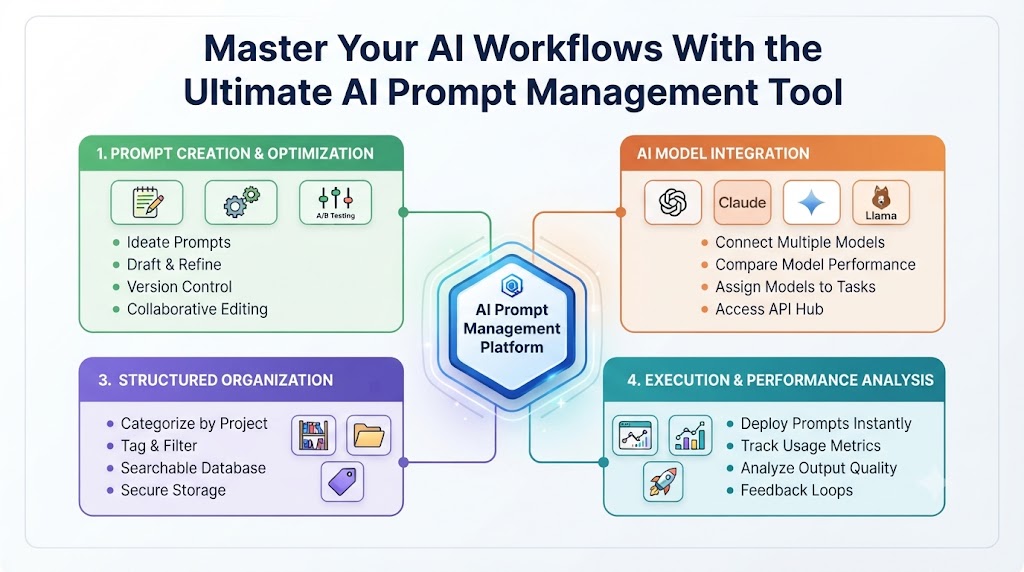
An AI prompt management tool is a dedicated digital platform designed to store, organize, edit, test, and share text instructions used for generative artificial intelligence models. Think of it as a specialized content management system tailored specifically for conversational AI models like OpenAI’s GPT series, Anthropic’s Claude, and Google Gemini.
Why Prompt Management Matters
As teams and individual creators rely more heavily on language models, prompts evolve from simple queries into complex, multi-layered instruction sets. Managing these instructions haphazardly results in wasted time and fragmented knowledge. A structured system ensures your best-performing instructions are instantly accessible, secure, and ready for deployment.
Common Prompt Challenges
- Scattered Knowledge: Prompts buried across personal notebooks, local text files, and hidden browser tabs.
- Loss of Context: Forgetting which specific phrasing or variable set produced a high-quality model output.
- Collaboration Friction: Team members rewriting the same workflows independently without a unified repository.
- Lack of Measurement: Inability to track performance changes over time.
Benefits of Organized Prompt Libraries
Transitioning to a dedicated AI prompt library centralizes your creative and technical assets. It enables rapid searching, tagging, version tracking, and seamless sharing across cross-functional teams, transforming ad-hoc experimentation into a predictable science.
UNDERSTANDING PROMPT ENGINEERING
What Prompt Engineering Is
Prompt engineering is the practice of structuring text instructions so that an artificial intelligence model interprets and responds to them with maximum accuracy, relevance, and safety. Grounded in research guidelines from foundational providers like OpenAI documentation and Anthropic documentation, effective engineering turns vague requests into precise instructions.
Prompt Components
A robust, production-ready instruction set typically contains several distinct components:
- Context: Background information setting the operational stage for the model.
- Instructions: Direct, step-by-step commands outlining what the model must execute.
- Variables: Dynamic placeholders (e.g.,
{{topic}}or{{audience}}) that allow reusable templates to adapt to new inputs. - Output Formatting: Explicit directives regarding layout, such as markdown, JSON, tables, or bullet points.
- Constraints: Clear boundaries specifying what the model should not do or avoid.
Implementing a structured prompt engineering platform helps developers and writers standardize these elements across every generation task.
BUILDING AN ORGANIZED AI PROMPT LIBRARY
Categories
Grouping your templates into distinct folders—such as marketing, software development, customer support, and academic research—keeps your repository clean and navigable.
Variables
Designing templates with modular variables makes a single text asset adaptable to hundreds of unique real-world scenarios.
Search and Collections
Robust search indexing enables users to locate exact text instructions within milliseconds, while custom collections bundle related templates for specific projects.
Prompt Reusability
Utilizing a dedicated AI prompt organizer ensures that your successful patterns become permanent, reusable assets that save countless hours of rewriting.
AI PROMPT OPTIMIZATION
Improving Prompt Clarity
Ambiguous language leads to unpredictable AI responses. Optimization focuses on stripping away fluff and replacing vague adjectives with concrete behavioral directions.
Better Instructions and Role Definition
Assigning a specific persona (e.g., “Act as a senior DevOps engineer”) instantly narrows the probability space of the model, steering it toward domain-specific accuracy. Referencing Google AI documentation and Microsoft Learn guidelines highlights the value of systematic persona conditioning.
Context Enhancement and Reducing Ambiguity
Providing reference text, style guidelines, or formatting examples drastically reduces hallucinations and misinterpretations. An advanced AI prompt optimizer automatically flags structural ambiguities and suggests refinement strategies.
AI PROMPT ANALYSIS
Prompt Structure and Goal Identification
Analyzing a prompt involves dissecting its architecture to ensure the primary objective aligns with the model’s capabilities.
Variable Detection and Output Expectations
An effective AI prompt analyzer inspects whether variables are correctly declared and checks if output constraints are clear enough to prevent formatting errors.
Safety Considerations and Quality Evaluation
Evaluating safety ensures instructions do not trigger harmful outputs or violate compliance policies, maintaining robust ethical standards in enterprise deployments.
PROMPT QUALITY CHECKING
Clarity, Context, and Structure
A high-grade prompt quality checker evaluates whether instructions are concise, contextually rich, and logically structured for optimal token consumption and inference performance.
Reusability, Safety, and Practical Value
Prompts are scored based on how easily they can be adapted by other team members and whether they consistently yield practical, production-ready results.
VERSION CONTROL FOR AI PROMPTS
Why Version History Matters
Just like source code, prompts evolve through iterative testing. A minor shift in wording can completely alter model behavior.
Prompt Evolution and Team Collaboration
Using a specialized prompt version control tool allows teams to review historical iterations, compare changes side-by-side, and roll back to stable versions if a recent edit degrades output quality.
TESTING AI PROMPTS
Comparing Outputs and Measuring Consistency
Testing ensures your instructions hold up across different base models and temperature settings.
A/B Prompt Testing and Experiments
An effective AI prompt testing tool lets you run side-by-side experiments to evaluate which variation produces superior results, ensuring data-driven optimization.
REUSABLE AI PROMPT TEMPLATES
- Writing: Outlines, essays, blog posts, and creative storytelling frameworks.
- Coding: Code refactoring, unit test generation, debugging scripts, and architecture documentation.
- Marketing: Email sequences, ad copy variations, social media calendars, and brand voice guidelines.
- Customer Support: Empathic response templates, ticket categorization, and escalation summaries.
- Research & Education: Literature reviews, syllabus generation, and complex concept breakdowns.
- Business & Productivity: Meeting summaries, SWOT analyses, and strategic planning frameworks.
Leveraging pre-built, reusable AI prompt templates accelerates project deployment across all organizational departments.
PROMPTOSIA FOR DIFFERENT USER TYPES
Writers
Streamline outlining, drafting, and editing workflows with tested narrative frameworks available in the Prompt Library.
Developers
Manage system prompts, API payload instructions, and code generation templates with absolute precision.
Marketers
Scale multi-channel campaigns using optimized copywriting templates and targeted audience variables.
Students
Break down complex subjects, organize study notes, and generate practice quizzes efficiently.
Researchers
Synthesize academic literature and structure data-gathering frameworks securely.
Educators
Design comprehensive lesson plans, interactive rubrics, and educational materials quickly.
Businesses
Standardize internal operations, customer service communications, and executive reporting workflows.
Content Creators
Generate viral hooks, script structures, and cross-platform publishing calendars seamlessly.
Agencies
Collaborate across client accounts with shared, version-controlled template repositories.
AI Professionals
Fine-tune system instructions, run rigorous experiments, and evaluate model performance at scale using the Prompt Analyzer.
BEST PRACTICES FOR PROMPT MANAGEMENT
- Save successful prompts immediately rather than letting them disappear in chat logs.
- Organize templates into logical categories and apply descriptive tags.
- Use clear, standardized variables for dynamic inputs.
- Test templates regularly against updated model versions.
- Maintain complete version history to track performance improvements.
- Document successful workflows in a central Help Center.
COMMON PROMPT ENGINEERING MISTAKES
- Vague Instructions: Leaving room for open-ended interpretation.
- Missing Context: Expecting the model to read your mind without background data.
- Overly Long Prompts: Cramming unrelated instructions into a single block of text.
- Lack of Testing: Deploying unverified instructions into production workflows.
- No Version Tracking: Losing track of which iteration produced the best output.
Avoid these pitfalls by leaning on structured optimization tools and community-driven best practices.
COMPARISON TABLE
| Feature | Manual Prompt Storage | Promptosia |
| Organization | Fragmented notes & chat history | Structured library with categories & tags |
| Version Control | None (overwrite risk) | Full version history & rollbacks |
| Search | Basic text search | Advanced indexing & tag filtering |
| Testing | Manual copy-pasting | Built-in testing & comparison tools |
| Quality Analysis | Subjective trial-and-error | Automated quality checking |
| Collaboration | Difficult file sharing | Real-time team workspaces |
THE FUTURE OF PROMPT ENGINEERING
As foundational models evolve, prompt engineering is shifting from an ad-hoc art into a rigorous engineering discipline. The future emphasizes automated optimization, team-wide template sharing, standardized prompt marketplaces, and seamless integration into automated business workflows. Maintaining a structured repository today ensures your organization stays ahead of rapid advancements in generative AI technology.
HOW PROMPTOSIA HELPS USERS BUILD BETTER PROMPTS
Promptosia offers a unified ecosystem designed to elevate your AI interactions. Through a centralized prompt library, automated optimization algorithms, detailed version history, and interactive Prompt Testing tools, users can refine their workflows effortlessly. Unique features like Prompt Passports and Prompt Duels foster community engagement and competitive refinement, helping you turn every interaction into a polished digital asset. Learn more about our mission on the About Page.
FREQUENTLY ASKED QUESTIONS (FAQ)
What is an AI prompt management tool?
An AI prompt management tool is a dedicated software platform that helps individuals and teams store, organize, optimize, test, and version their generative AI instructions in a centralized repository.
Why should I save AI prompts?
Saving prompts prevents you from losing valuable workflows in chat history, saves time on rewriting, ensures consistent output quality, and allows you to reuse successful templates across different projects.
What is prompt engineering?
Prompt engineering is the systematic practice of designing, structuring, and refining text instructions so that artificial intelligence models interpret them accurately and deliver precise, reliable outputs.
How does prompt optimization work?
Prompt optimization involves analyzing instruction clarity, enhancing context, defining specific personas, and removing ambiguity to help language models generate higher-quality, more consistent responses.
Why is prompt testing important?
Prompt testing ensures your instructions produce stable and accurate outputs across different model versions, helping you catch edge cases and formatting errors before deploying them into production.
What is prompt version control?
Prompt version control tracks the iterative history of your instructions, allowing you to view past changes, compare variations side-by-side, and roll back to stable versions whenever needed.
How does an AI prompt analyzer help?
An AI prompt analyzer inspects your text structure, detects missing variables, evaluates safety considerations, and suggests improvements to maximize overall instruction effectiveness.
What makes a high-quality prompt?
A high-quality prompt features clear instructions, relevant background context, explicit output formatting constraints, and modular variables that adapt easily to new scenarios.
Can teams collaborate on prompt libraries?
Yes, modern prompt management platforms allow team members to share repositories, co-edit templates, maintain version histories, and standardize AI workflows across entire organizations.
Who should use Promptosia?
Promptosia is designed for writers, developers, marketers, researchers, educators, students, agencies, and businesses looking to streamline their AI interactions and build reusable prompt assets.
CONCLUSION
Mastering artificial intelligence workflows requires more than just great models; it requires disciplined organization, continuous optimization, and structured prompt management. By moving away from scattered chat logs and adopting a systematic approach to prompt engineering, version control, and quality checking, you unlock consistent, professional results. Implementing these practices transforms casual queries into valuable digital assets that scale with your ambitions. Embrace the power of structured prompt systems, refine your workflows continuously, and elevate your generative AI capabilities today.